115,006 Large-Trade Alerts: Where and When Crypto Whales Trade, by Venue and Hour
Every large-trade alert Vultax logged on six exchanges from 18 June to 3 September 2026: HTX carried 56% of large-trade notional, flow stayed close to balanced, 13:00–16:00 UTC held 23.6% of alerts, and weekends ran 23–30% quieter.
Live now — refreshed every 10 minutes
updated 02:30 UTC, refreshes every 5 min
- Whale events, 24 h
- 1,338
- Whale notional, 24 h
- $101.95M
- Largest event, 24 h
- $1.23M
- Prints of $100K+ on public tapes, 30 min
- 8
Vi IQ, BTC on the major spot venues
6 of 6 domains, 21/21 source answered , how it is computed
- Market quality
- 100
- Liquidity health
- 87
- Order flow
- 51
- Arbitrage potential
- 0
- Volatility
- 94
- News & attention
- 100
Alerts logged
0115,006
18 June to 3 September 2026 across Binance, HTX, Coinbase, Gate.io, Kraken and KuCoin; 60 days with data
- HTX share of large-trade notional
- 056%
- 19,617 single large trades worth $2.88B; Binance printed more large trades, 20,022, worth $1.10B
- Peak window
- 013:00–16:00 UTC
- 23.6% of all large-trade alerts in four hours; the busiest hour (15:00) ran 1.9 times the quietest (23:00)
- Buy share
- 0.051.1%
- Alerts flagged as buys; between 47.5% and 52.6% on every venue and 49.2% to 53.4% in every hour of the day
The short answer
Vultax logged 115,006 large-trade alerts on six exchanges from 18 June to 3 September 2026. Binance printed the most large trades, 20,022, but HTX carried the most money: 19,617 large trades worth $2.88B, 56% of large-trade notional, with a 90th-percentile print of $364,000 against Binance's $84,000. The largest single print was a $7.06M BTC-USD sell on Coinbase on 27 June.
Direction barely moved. 51.1% of alerts were buys, between 47.5% and 52.6% on every venue and between 49.2% and 53.4% in every hour of the day. What moved was how much printed: the four hours from 13:00 to 16:00 UTC carried 23.6% of all alerts, the busiest hour ran 1.9 times the quietest, and Saturday and Sunday ran 23% and 30% below the weekday average.
What was measured
The Vultax whale tracker watches exchange trade feeds and raises an alert when a print is large for its pair and venue. Every alert is stored with the exchange, pair, side, price, quantity and notional at the moment it fired, stamped to the second in UTC. This page reports that log, unfiltered, for the 78 days from 18 June to 3 September 2026: 115,006 alerts from six exchanges, on 60 days with data. The 18 days without data are collection gaps and are reported as gaps rather than filled.
Three detectors contribute. A single large trade fires when one print clears the notional threshold for its pair, which sat at roughly $29,000 at the low end during this window. A burst fires when several large trades land inside a 45-second window. A momentum alert fires on three or more consecutive large trades on the same side. One trade can trigger more than one detector, so alerts outnumber trades: 59,803 of the alerts are single large trades, 34,948 are bursts, and 20,255 are momentum alerts.
Hour and weekday figures below are shares or averages of all alerts over the window, on days with data.
Large-trade alerts per day, six exchanges
18 June to 2 September 2026. Days with no data are days the detector was not running.
Chart: Vultax Research
Show the numbers
| Point | Alerts |
|---|---|
| 06-18 | 1,891 |
| 06-19 | 1,847 |
| 06-20 | 1,586 |
| 06-21 | 1,529 |
| 06-22 | 2,228 |
| 06-23 | 1,515 |
| 06-24 | 2,916 |
| 06-25 | 3,428 |
| 06-26 | 3,769 |
| 06-27 | 1,730 |
| 06-28 | 1,631 |
| 06-29 | 2,554 |
| 06-30 | 2,929 |
| 07-01 | 3,168 |
| 07-02 | 2,892 |
| 07-03 | 1,957 |
| 07-04 | 1,730 |
| 07-05 | 1,680 |
| 07-06 | 2,642 |
| 07-07 | 2,446 |
| 07-08 | 2,119 |
| 07-09 | 978 |
| 07-10 | 2,176 |
| 07-11 | 1,449 |
| 07-12 | 1,422 |
| 07-13 | 2,603 |
| 07-14 | 2,473 |
| 07-15 | 2,287 |
| 07-16 | 2,123 |
| 07-17 | 2,307 |
| 07-21 | 107 |
| 07-22 | 1,242 |
| 08-04 | 292 |
| 08-05 | 816 |
| 08-06 | 1,981 |
| 08-07 | 2,236 |
| 08-09 | 429 |
| 08-10 | 314 |
| 08-11 | 1,125 |
| 08-12 | 2,054 |
| 08-13 | 1,119 |
| 08-14 | 2,245 |
| 08-15 | 536 |
| 08-16 | 1,210 |
| 08-17 | 2,458 |
| 08-18 | 2,108 |
| 08-19 | 3,211 |
| 08-20 | 1,620 |
| 08-21 | 2,273 |
| 08-22 | 2,386 |
| 08-23 | 2,069 |
| 08-24 | 3,017 |
| 08-25 | 2,861 |
| 08-26 | 2,176 |
| 08-27 | 1,810 |
| 08-28 | 2,110 |
| 08-31 | 2,063 |
| 09-01 | 1,002 |
| 09-02 | 2,088 |
Download chart figures:CSVJSON with sourcesSVG chart
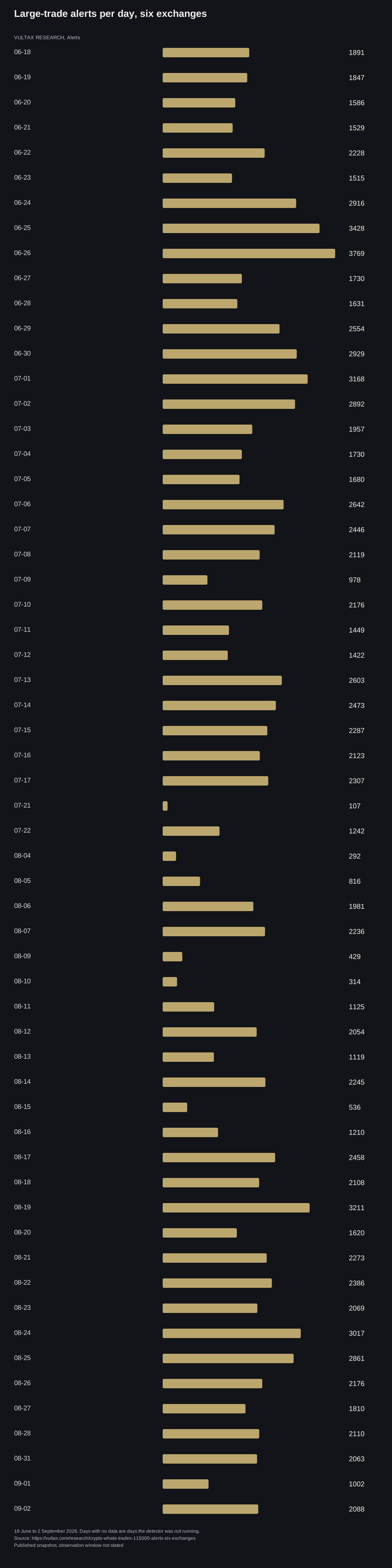
- Venues — Binance, HTX, Coinbase, Gate.io, Kraken and KuCoin, the six where the trade feed was complete enough to run detection
- Pairs — BTC accounts for 81% of alerts (BTC/USDT and BTC-USD together), ETH/USDT for 12%, SOL for 5.5%
- Notional — every figure is the print's own price times quantity; alerts that share a trade are double-counted in the $11.38B all-alert total, so venue comparisons below use single large trades only
Who prints the biggest
Counting single large trades only, Binance produced the most prints and HTX produced the most money. HTX's median large trade was $65,000 and its 90th percentile $364,000, more than four times Binance's $84,000.
Put differently, HTX accounted for a third of the large trades in the sample and 56% of the large-trade notional. The gap widened over the summer: HTX large-trade notional went from $0.58B in June to $0.84B in July and $1.39B in August, while Binance went from $0.24B to $0.38B to $0.44B.
A large print is not, by itself, evidence of genuine demand. The academic literature on crypto volume, summarised in our wash-trading study, finds that reported activity on some venues is dominated by trades with no economic purpose, and a venue where prints are structurally larger deserves the same question. That is why the terminal shows a venue-quality score next to every print instead of ranking venues by size. Nothing here is a claim about why HTX prints are larger; it is a measurement of the fact that they are.
| Venue | Large trades | Median print | 90th percentile | Notional |
|---|---|---|---|---|
| HTX | 19,617 | $65K | $364K | $2.88B |
| Binance | 20,022 | $43K | $84K | $1.10B |
| Coinbase | 11,294 | $46K | $86K | $0.68B |
| Gate.io | 5,480 | $44K | $92K | $0.30B |
| Kraken | 1,804 | $46K | $73K | $0.09B |
| KuCoin | 1,586 | $39K | $74K | $0.08B |
Download table figures:CSVJSON with sources
How big a whale is
Most alerts are not enormous. 91,246 of the 115,006 (79%) were under $100,000. Another 15,572 fell between $100,000 and $250,000, 5,098 between $250,000 and $500,000, and 2,482 between $500,000 and $1M. Only 604 alerts were between $1M and $5M, and four exceeded $5M. Those 608 prints above $1M carried $0.94B, about 8% of all alert notional, from half a percent of the alerts.
The five largest prints in the window were a $7.06M BTC-USD sell on Coinbase on 27 June, a $5.45M ETH/USDT sell on HTX on 19 August, a $5.26M BTC/USDT sell on HTX on 13 July, a $4.69M BTC-USD buy on Coinbase on 20 August, and a $4.24M BTC-USD sell on Coinbase on 27 June. Four of the five were sells.
Flow was close to balanced, and clustering is the signal
51.1% of all alerts were buys. No venue strayed far from that: KuCoin was lowest at 47.5% buys and HTX highest at 52.6%. Across the last three weeks of the window the daily buy share ranged from 49.4% to 56.5%. At the level of raw counts, large flow was near-balanced on most days. By hour of day the band was just as narrow, from 49.2% buys at 15:00 UTC to 53.4% at 06:00 UTC: the U.S.-morning surge described below is a surge in both directions.
What separates a day is not the count of large prints but how they cluster. The burst detector fired 34,948 times and the momentum detector 20,255 times, and those clusters, not isolated prints, are what a whale-flow read is built on. A single $400,000 buy is a data point. Six of them inside a minute on two venues is a position being built.
What the tape looks like below the threshold
For scale, a 25% sample of every BTC trade on Binance and Coinbase over the 24 hours to 3 September 2026 puts the median Binance BTC/USDT print at five dollars, the 90th percentile at $383 and the 99th at $6,575. On Coinbase the median was $25, the 90th percentile $1,699 and the 99th $11,413. Trades of $100,000 or more made up 4.4% of sampled notional on Binance and 2.8% on Coinbase.
A $50,000 alert therefore sits more than 100 times above the median Binance trade and around the 99.5th percentile of the tape. Whale alerts are, by construction, the far tail, which is why a handful of them carries so much of the notional.
The daily curve
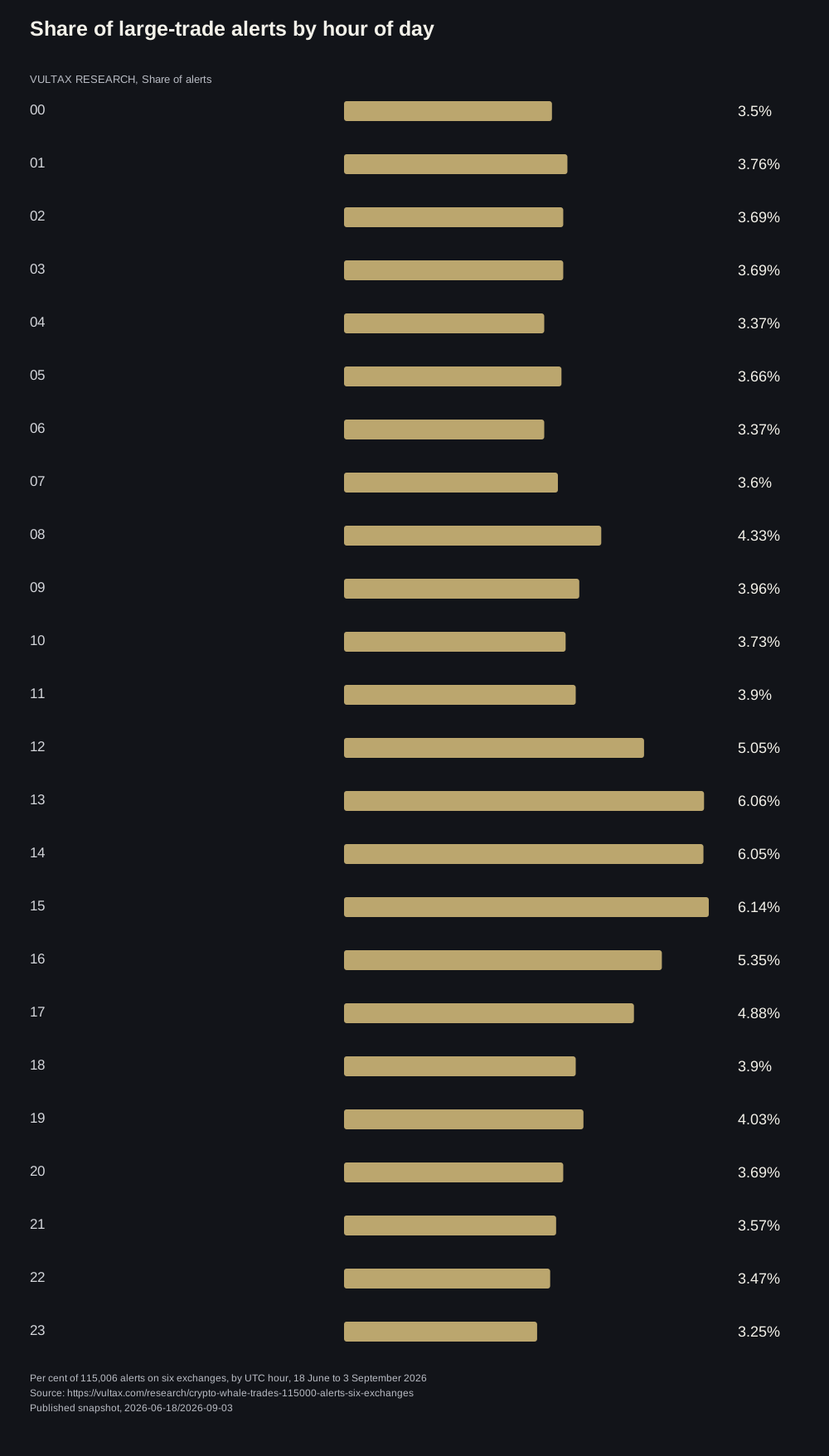
Large prints follow the sun into North America. From 23:00 to 06:00 UTC each hour carries between 3.3% and 3.8% of the day's alerts. Activity lifts through the European morning, reaches 5.05% at 12:00 UTC, and holds above 6% for three consecutive hours from 13:00 to 15:00 UTC, the window that contains the U.S. equity open at 13:30 UTC and the overlap of the European afternoon. The busiest hour, 15:00 UTC, carried 6.14% of all alerts; the quietest, 23:00 UTC, carried 3.25%. That is a 1.9-to-1 ratio between the loudest and quietest hours of the day.
The shape matches what the academic record shows for bitcoin volume generally. Eross, McGroarty, Urquhart and Wang found bitcoin trading activity peaks during U.S. market hours and troughs in the Asian night, and Baur, Cahill, Godfrey and Liu documented time-of-day and day-of-week effects in bitcoin volume that persist even though the market never closes. What this log adds is that the pattern holds for the far tail of the tape, not just for total volume.
Share of large-trade alerts by hour of day
Per cent of 115,006 alerts on six exchanges, by UTC hour, 18 June to 3 September 2026
Chart: Vultax Research
Show the numbers
| Category | Share of alerts |
|---|---|
| 00 | 3.5% |
| 01 | 3.8% |
| 02 | 3.7% |
| 03 | 3.7% |
| 04 | 3.4% |
| 05 | 3.7% |
| 06 | 3.4% |
| 07 | 3.6% |
| 08 | 4.3% |
| 09 | 4.0% |
| 10 | 3.7% |
| 11 | 3.9% |
| 12 | 5.0% |
| 13 | 6.1% |
| 14 | 6.0% |
| 15 | 6.1% |
| 16 | 5.3% |
| 17 | 4.9% |
| 18 | 3.9% |
| 19 | 4.0% |
| 20 | 3.7% |
| 21 | 3.6% |
| 22 | 3.5% |
| 23 | 3.3% |
Download chart figures:CSVJSON with sourcesSVG chart
Each venue keeps its own clock
Venues differ in how much of their large flow lands in the U.S. morning versus overnight. KuCoin, Kraken and Gate.io are the most U.S.-morning heavy: 29.4%, 28.9% and 27.5% of their alerts fell between 13:00 and 16:00 UTC. Binance is the most overnight heavy, with 26.7% of its alerts between 00:00 and 06:00 UTC, followed by Gate.io at 25.3% and HTX at 25.1%. KuCoin's overnight share was the lowest at 17.2%.
The practical consequence is that the same $300,000 print carries different context on different venues at the same hour. At 04:00 UTC it sits in Binance's busy period and in KuCoin's quiet one; a print that is one of dozens is ordinary, and one that is nearly alone is worth a second look. The whale tracker shows the recent count per venue for that reason.
| Venue | Share of its alerts, 13:00–16:00 UTC | Share of its alerts, 00:00–06:00 UTC |
|---|---|---|
| KuCoin | 29.4% | 17.2% |
| Kraken | 28.9% | 22.4% |
| Gate.io | 27.5% | 25.3% |
| Coinbase | 24.5% | 22.6% |
| HTX | 23.0% | 25.1% |
| Binance | 22.2% | 26.7% |
Download table figures:CSVJSON with sources
The week
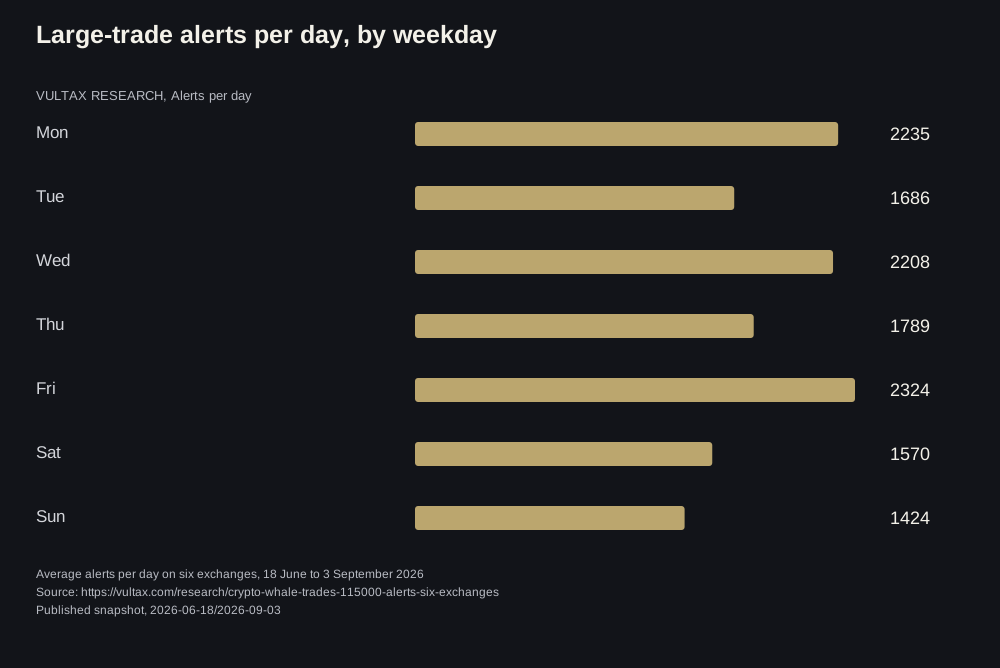
Weekdays averaged 2,048 alerts per day. Friday was the busiest at 2,324 per day, then Monday at 2,235 and Wednesday at 2,208; Tuesday and Thursday sat lower at 1,686 and 1,789. Saturday averaged 1,570 alerts and Sunday 1,424, 23% and 30% below the weekday average. Crypto trades on weekends, but its large prints thin out.
Large-trade alerts per day, by weekday
Average alerts per day on six exchanges, 18 June to 3 September 2026
Chart: Vultax Research
Show the numbers
| Category | Alerts per day |
|---|---|
| Mon | 2,235 |
| Tue | 1,686 |
| Wed | 2,208 |
| Thu | 1,789 |
| Fri | 2,324 |
| Sat | 1,570 |
| Sun | 1,424 |
Download chart figures:CSVJSON with sourcesSVG chart
How to use the clock
Thresholds set once and applied around the clock will fire constantly at 15:00 UTC and rarely at 23:00 UTC. A threshold that tracks the hour's typical rate makes an alert mean the same thing at any time of day. The other use is reading a print in context: a large trade in a venue's quiet window has fewer peers and is harder to hide inside ordinary flow, which is exactly the kind of context the terminal attaches to each alert.
How to read the live figures
The strip at the top of this page is not a screenshot of the day this was written. Every ten minutes Vultax re-reads its own whale-event table for the last 24 hours, the public trade tapes of five venues for prints of $100,000 or more, Binance funding, Bybit open interest and Deribit's DVOL and rewrites the figures; the Vi IQ beneath them scores the same six domains the terminal scores for a pair, computed for BTC on the major spot venues, with any domain that cannot be computed shown as unavailable rather than filled in. Read the numbers as a live check on the argument above, and the revision notes at the end for what has changed since publication.
The first three figures come from Vultax's own detection across the exchange streams it watches: how many large-trade events fired in the last 24 hours, their combined notional, and the largest single one. The fourth is independent: the count of prints of $100,000 or more on the public tapes of Coinbase, Binance, Kraken, OKX and Bybit in the last thirty minutes. When the two disagree it is usually because the largest prints are on venues the public tapes do not cover; the pack behind the page breaks the day's events down by exchange.
Context from elsewhere: on-chain whales are not tape whales
Most 'whale' coverage in 2026 is about on-chain movements, and it is measuring something different from this article. CoinDesk reported in July 2026 that large holders accumulated about 270,000 BTC in two weeks while U.S. spot ETFs saw a record $4 billion of outflows, and CryptoQuant's exchange whale ratio, the share of exchange inflows coming from the ten largest deposits, reached a ten-month high in January with Glassnode measuring spot volume at its lowest since November 2023. Those are wallet-to-exchange transfers and holdings, and much of the largest flow is ETF custody moving between custodians.
This article counts prints: trades that executed on an exchange's tape above a threshold. A transfer onto an exchange is a possible sale; a print is a sale, with a side, a venue and a time. The two series can move in opposite directions for weeks, as they did in the summer of 2026, and the hour-by-hour pattern described here belongs to the tape, not to the chain.
Method and limits
Alerts count detector events, not unique trades, and thresholds differ by pair and venue, so a venue with more small pairs under coverage will show more alerts per dollar. Detection ran on six venues where the trade feed was complete; the terminal covers more venues for order books than for trades. Eighteen of the 78 days have no data and are excluded rather than interpolated. All notional is measured at the print price and is not adjusted for the same capital cycling through a venue. The raw alert log is retained, so every figure here can be recomputed. Hour-of-day shares are pooled over 60 days of data and six venues, so a single venue's curve is noisier than the aggregate, and the clock describes when large prints were logged, not whether trading at any hour is better or worse.
To watch large prints as they happen, the BTC venue desk in the Vultax terminal shows whale trades alongside each venue's book, the cross-exchange gap and liquidity.
- Window — 2026-06-18 to 2026-09-03 00:26 UTC, 60 days with data
- Threshold — pair- and venue-specific; the smallest alert in the window was about $29,000
- Dataset — daily alerts, large trades, bursts, momentum alerts, buy share and notional by exchange are available as a CSV on this page
Downloads contain the published study figures. Changing market widgets are separate. Use Vultax research with an AI assistant. Press note.
Questions this page answers
- What counts as a whale trade in crypto?
- Here, a single print at or above Vultax's size threshold on an exchange's trade tape, with the venue, side and time recorded. On-chain trackers use a different definition, a large transfer between wallets or onto an exchange, which is a possible trade rather than one.
- Which exchange has the most whale trades?
- In Vultax's log from 18 June to 3 September 2026, Binance had the most single large trades (20,022) and HTX the most notional ($2.88B, 56% of large-trade notional), followed by Coinbase with 11,294 trades and $0.68B. The live strip shows the last 24 hours.
- What is the best time of day to trade crypto?
- For size, the hours when large prints cluster. In this log that was 13:00 to 16:00 UTC, the U.S. morning and the European afternoon, which carried 23.6% of alerts; the quietest hour was 23:00 UTC. Weekends ran 23% to 30% below the weekday average. That describes when large prints happen, not whether any hour is better to trade.
- Are whale alerts useful for trading?
- As context, yes; as a signal, rarely on their own. Flow in this sample was close to balanced over long windows, and a large print tells you what happened, not what happens next. The hour-by-hour and per-venue patterns on this page are the durable part.
- How do on-chain whale metrics differ from these?
- They measure transfers and balances rather than executed trades, and in 2026 much of the largest on-chain flow is ETF custody. CoinDesk's July 2026 report of whales accumulating 270,000 BTC while ETFs bled is an on-chain finding; the tape can say something different in the same weeks.
Revision notes
This page is kept current. Each entry records what changed and when; the live figures above refresh on their own.
- Now also covers when large trades happen: the hour-by-hour curve, the weekend drop and each venue's own clock, with charts and a venue table.
- Added the distinction between on-chain whale metrics (CryptoQuant, Glassnode, the July 2026 accumulation) and the tape-based counts this article uses.
- Live figures and a Vi IQ for this subject now refresh every ten minutes on this page from outside sources and Vultax's own tables; a context section, the questions below and these revision notes were added.
Sources and evidence
- Vultax whale tracker — how large-trade, burst and momentum alerts are raised
Alert definitions, the venue, side, size and timing context stored with each print, and the per-venue recent count
- Vultax methodology — data sources and coverage
Trade-feed sources, coverage limits and the explicit-gap standard
- Vultax — Crypto Wash Trading: What the Research Actually Shows
Why large reported activity on a venue is not by itself evidence of genuine demand
- Kyle, A. S. (1985). Continuous Auctions and Insider Trading. Econometrica 53(6)
The canonical model of how informed large orders move price and why size is read as information
- Easley, D., López de Prado, M., O'Hara, M. (2012). Flow Toxicity and Liquidity in a High-Frequency World. Review of Financial Studies 25(5)
Order-flow imbalance as a measure of informed trading, the basis for reading clustered same-side prints
- Makarov, I., Schoar, A. (2020). Trading and arbitrage in cryptocurrency markets. Journal of Financial Economics 135(2)
Venue segmentation in crypto markets and why the same flow looks different across exchanges
- Binance spot WebSocket streams documentation
Trade and aggregate-trade stream semantics that determine what a single print is
- CoinDesk — Bitcoin whales bought 270,000 BTC in two weeks even as ETFs bled a record $4 billion (3 Jul 2026)
Large holders accumulated while U.S. spot ETF demand ran in reverse: on-chain accumulation and exchange tape are different measurements of the same word.
- Yahoo Finance — Bitcoin whales accelerate exchange activity in early 2026 amid fragile liquidity
CryptoQuant's exchange whale ratio (top-10 inflows over all inflows) at a ten-month high; Glassnode spot volume at its lowest since November 2023.
- Eross, A., McGroarty, F., Urquhart, A., Wang, S. (2019). The intraday dynamics of bitcoin. Research in International Business and Finance 49
Intraday volume and liquidity patterns in bitcoin, peaking in US hours
- Baur, D. G., Cahill, D., Godfrey, K., Liu, Z. F. (2019). Bitcoin time-of-day, day-of-week and month-of-year effects in returns and trading volume. Finance Research Letters 31
Calendar effects in bitcoin volume in a market that never closes
- NYSE trading hours and calendars
The 13:30 UTC US equity open that sits inside the peak window
- CME Group — Bitcoin futures contract specifications
Regulated derivatives hours that overlap the US-session surge
Figures describe large-trade alerts logged by Vultax detection pipelines from observed exchange trade feeds over the stated window. They are not a statement about any exchange's conduct, are not an allegation of wrongdoing by any venue or participant, and nothing here is financial advice.
Watch this measurement live in Vultax.
Watch large bitcoin trades as they print, alongside each venue's order book, the cross-exchange gap and liquidity.
Get the data behind this study.
Daily large-trade alerts by exchange, 18 June to 2 September 2026 (CSV), as a CSV, plus one email when the next study publishes.
Continue reading
Best Polymarket Tools and Whale Trackers in 2026: 22 Compared, 4 Publish Their Latency
22 Polymarket tools compared on latency, P&L method, history, liquidity context and price, including eight whale trackers. Vendor checks: 5 September 2026; Polywhaler corrected 26 September. Four publish latency figures; every category has a free tier.
Polymarket Insider Trading: The Charged Cases, and What a Screen Catches
The long-shot screen tested on historical Polymarket fills, with a correction to the tight screen: 1,316 bets and a matched gap of −5.40 cents per share. Earlier sensitivity tables are retained as historical results.
Polymarket's Up-or-Down Crypto Markets: 60% of Its Trades, Priced About Right, 1.6% Fee
Vultax counted 15.0 million Polymarket trades over 251 hours: 59.6% were up-or-down crypto bets, 379 wallets made most of them, and takers paid about 1.6% of notional on five-minute trades. In 2,497 markets checked against outcomes, Up won 50.2% and favourites won as often as priced.
Crypto Wash Trading and Real Liquidity: Fake-Volume Estimates Run From 51% to 95%
Published estimates put fake or non-economic bitcoin volume at 51% to 95%, and above 70% on unregulated venues. Why the studies disagree, why depth and slippage judge a venue better than volume (Binance: 64.3% of volume, 30.7% of depth, per Kaiko), and what to check yourself.