Polymarket Copy Trading: Following 30 Seconds Late Cost 1.43¢ a Share, Before Fees
What copying a Polymarket trader costs, measured and worked. Behind buys by the 1,000 most profitable wallets, a follower 30 seconds late paid 1.43¢ a share more in event markets; fees and fill put a copier of a $50 crypto trade down about 6% before the market moves. Four tools compared.
AI-assisted drafting, research and editing. Published by OmniOS OÜ. How we use AI
Live now — refreshed every 10 minutes
updated 20:20 UTC, refreshes every 5 min
- Median trade, 24 h
- $48
- One-trade wallets, 24 h
- 31.6%
- Trades of $10K+, last hour
- 58
- Wallets active, 24 h
- 18,502
Vi IQ, Polymarket as a venue, 24 h
4 of 6 domains , how it is computed
- Market quality
- n/a
- Liquidity health
- n/a
- Order flow
- n/a
- Arbitrage potential
- n/a
- Volatility
- n/a
- News & attention
- n/a
Extra paid 30 seconds after a top trader's buy
+0.001.43¢
Average over 17,088 event-market buys by the top 1,000 wallets, 12–13 September 2026; the follower paid more on 57.9% of them
- Copier's cost on a $50 crypto trade
- 06%
- 100 contracts at 50 cents: $1.75 Polymarket taker fee (published formula) + $0.25 platform fee at 0.5% + $1.00 if the leader moved the price one cent
- Extra paid behind the top 100 wallets
- +0.001.97¢
- 30 seconds late, against +1.20¢ behind wallets ranked 101 to 1,000
- Active winners profitable again next month
- 0124 of 137
- June winners among wallets with ten or more trades in both June and July 2026. Across all wallets active in consecutive months from March 2025 to March 2026 (431 million fills, 13 month pairs), winners repeated 41–51% of the time. The decisions persist among the active few; the returns are what the copier cannot have.
The short answer
Copy trading on Polymarket copies a trader's decisions, not their returns, and the price moves before the copy arrives. Vultax followed 54,828 buys by the 1,000 most profitable wallets in its Polymarket cohort on 12 and 13 September 2026. Across 17,088 of them in event markets, a follower 30 seconds late paid 1.43 cents a share more on average, and paid more than the leader 57.9% of the time. Ten minutes late, the extra was 1.29 cents: most of the cost was already in the price within the first half-minute.
Fees and fill add to it. Worked from the published fee formula, a copier who follows a 100-contract buy at 50 cents in a crypto market is down about $3.00 on a $50 stake, 6%, before the market moves at all, counting the taker fee, a 0.5% platform fee and a fill one cent worse. Politics markets cost about 4.5%; geopolitics, which Polymarket does not charge fees on, about 2.5%.
The tools differ mainly in custody and automation. Polycopy is non-custodial, free to follow and paper-trade, $30 a month to run live bots, and charges 0.5% per executed trade. LuckyLobster runs agents on managed wallets. Laika Labs and Alphascope are leaderboard-and-alert products that leave execution to you.
The tools
Four products that let you follow a Polymarket wallet, plus the simulator, read from each vendor's own pages on 5 September 2026.
| Tool | How copying works | Custody | Fees | Stated latency | Free tier |
|---|---|---|---|---|---|
| Polycopy | Follow traders; Copy Score on every profile; Premium runs "Real Trading bots" that place live orders and "Auto-close positions" when the leader exits | Non-custodial: "You maintain full ownership of your wallet and funds at all times" | 0.5% flat on executed real trades; none on paper trades | Not stated | Follow unlimited traders, full feed, up to 10 paper-trading bots running 7 to 14 simulated days; Premium $30/mo with 7-day trial |
| Laika Labs | Leaderboard with alerts when a tracked wallet opens or closes; execution is manual | Your wallet | Not stated | "within 60 seconds" per third-party guides; the vendor site blocked automated reading | Free account per third-party guides |
| LuckyLobster | A built-in "Copy Trade" strategy that mirrors "top-performing wallets" inside an autonomous agent | "managed wallets" | Not stated; a paid tier is announced as upcoming | "sub-50ms latency" (press release, 23 February 2026) | Not stated |
| Alphascope wallet tracker | Wallet lookup and a local watchlist for copy research; no execution | n/a | Free | Not stated | Yes |
| Vultax paper trading | Simulated fills against live Polymarket prices; labelled lag on the desk | No funds | None | Printed on the surface | Free to browse; paid plans on pricing |
Download table figures:CSVJSON with sources
The three costs, worked
Polymarket's taker fee is C × feeRate × p × (1 − p), where C is contracts and p the price; makers pay nothing. The rate is 0.07 on crypto, 0.05 on sports, economics, culture and weather, 0.04 on finance, politics, mentions and tech, and zero on geopolitical markets. At p = 0.50 the fee is at its maximum, so the worked example below is the worst case at the most common price. The Polymarket fee calculator applies it to any size, price and category.
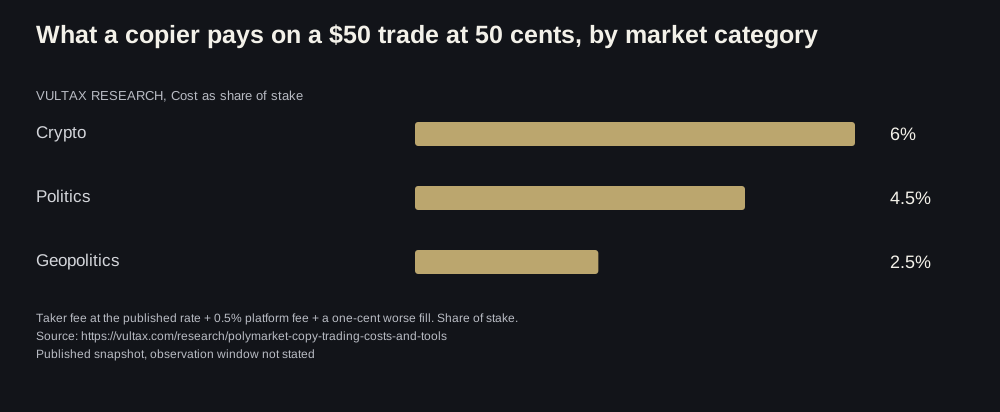
Suppose the leader buys 100 Yes contracts at 50 cents in a crypto market. Their stake is $50. Your copy, placed as a market order a few seconds later, pays three things the leader did not.
What a copier pays on a $50 trade at 50 cents, by market category
Taker fee at the published rate + 0.5% platform fee + a one-cent worse fill. Share of stake.
Chart: Vultax Research
Show the numbers
| Category | Cost as share of stake |
|---|---|
| Crypto | 6% |
| Politics | 4.5% |
| Geopolitics | 2.5% |
| Cost | Crypto (rate 0.07) | Politics (rate 0.04) | Geopolitics (no fee) |
|---|---|---|---|
| Taker fee on your entry, 100 × rate × 0.5 × 0.5 | $1.75 | $1.00 | $0.00 |
| Platform fee at 0.5% of stake (Polycopy) | $0.25 | $0.25 | $0.25 |
| Fill one cent worse than the leader's | $1.00 | $1.00 | $1.00 |
| Total, and share of a $50 stake | $3.00 (6.0%) | $2.25 (4.5%) | $1.25 (2.5%) |
Download table figures:CSVJSON with sources
Download chart figures:CSVJSON with sourcesSVG chart
- The leader paid none of these if they posted a limit order - "Makers are never charged fees", so a leader who rests orders keeps the 3.5% you paid to take.
- The costs repeat on exit - the same three land again when the position is closed or auto-closed, so a round trip in a crypto market costs a copier roughly 12% of stake at 50 cents.
- Speed helps only if it is measured - a sub-50 ms mirror still takes liquidity and still pays the fee; it reduces drift, not the other two costs, and in the measurement below most of the drift was already in the price 30 seconds after the leader's trade.
The cost of arriving late, measured
The worked example assumes a fill one cent worse than the leader's; Vultax measured the move instead. The leaders are the 1,000 wallets with the highest observed profit in its cohort of 80,000 Polymarket traders as refreshed on 12 September; the 1,000th had an observed profit of about $154,000. Of the 1.86 million trades recorded between 15:06 UTC on 12 September and 22:55 UTC on 13 September, 54,828 were the leaders' buys at prices between 3 and 97 cents, by 195 of the 1,000 wallets.
The follower's price is the first buy of the same outcome by any other wallet at or after the delay, provided one happened within five minutes of that mark; the leader's own later buys were skipped, so a leader splitting an order does not count as its own follower. Up-or-down markets were measured at 30 seconds only, because a five-minute market has usually settled before a ten-minute delay ends.
In event markets, everything except the up-or-down crypto series, the follower paid 1.43 cents more per share at 30 seconds and at two minutes, and 1.29 cents at ten, with a median extra of about 1.4% to 1.7% of the leader's price at every delay. That pattern fits a price that moves at or just after the leader's own trade, before any realistic copier arrives. In up-or-down markets the delay hardly mattered: 0.42 cents, with the follower paying more 52.9% of the time, close to a coin flip.
A trade recorded at that later price does not show that your own quantity would have filled there, and a buy with no other buyer in the five minutes after the mark is outside the estimate. A copier's own record needs the missed trades beside the filled ones: a table of successful entries can describe a different strategy from the one an alert would have let you follow.
What the 30-second measurement compares, and what it leaves to you
1A leader buys
price p
One of the 1,000 highest-profit wallets buys at between 3 and 97 cents.
2The next buyer, 30 seconds on
p + 1.43¢
Average over 17,088 event-market buys. The later buyer paid more on 57.9% of them, the same on 7.8% and less on 34.3%.
3Your own order
not measured
How many shares fill at that price, the taker fee for the market's category, and the buys that no later trade could be matched to.
Illustration100 shares × $0.0143 = $1.43The measured average, multiplied out. It is not the fill of a real 100-share order, and it is before fees.
| Market and delay | Buys measured | Average extra paid | Median, share of leader's price | Follower paid more | Same price | Follower paid less |
|---|---|---|---|---|---|---|
| Event markets, 30 seconds | 17,088 | +1.43¢ | +1.41% | 57.9% | 7.8% | 34.3% |
| Event markets, 2 minutes | 15,908 | +1.43¢ | +1.59% | 56.2% | 4.9% | 38.9% |
| Event markets, 10 minutes | 12,641 | +1.29¢ | +1.69% | 53.8% | 3.0% | 43.3% |
| Up-or-down markets, 30 seconds | 12,979 | +0.42¢ | +1.92% | 52.9% | 1.2% | 46.0% |
Download table figures:CSVJSON with sources
The best wallets are the most expensive to follow
Split by rank, the gap widens at the top. Behind the 100 most profitable wallets, a follower paid 1.97 cents more after 30 seconds and 2.39 cents after ten minutes, and paid more on 60.6% of 30-second follows. Behind wallets ranked 101 to 1,000 the figures were 1.20 and 0.80 cents.
One reading is that the top wallets trade earlier on information that the market then prices in; another is that their orders are larger and move thin books further. This study cannot separate the two, but both mean the same thing for a copier: the traders worth copying are the ones whose trades leave the least on the table.
Average extra paid by a follower, by the leader's rank
Cents per share in event markets, 12–13 September 2026
- Top 100 wallets
- Wallets ranked 101 to 1,000
Chart: Vultax Research
Show the numbers
| Category | Top 100 wallets | Wallets ranked 101 to 1,000 |
|---|---|---|
| 30 seconds | 2.0 ¢ | 1.2 ¢ |
| 2 minutes | 1.9 ¢ | 1.2 ¢ |
| 10 minutes | 2.4 ¢ | 0.8 ¢ |
Download chart figures:CSVJSON with sources
The buys with no later buyer, by rank
The delay figures count only the buys that a later buyer could be found for. The rest are the leader buys where no other wallet bought the same outcome in the five minutes after the delay mark: the trades a follower could not even have priced from a later trade. Split by rank in event markets, the top 100 wallets had more of them in the first minutes: 25.5% of their buys at 30 seconds and 30.5% at two minutes, against 21.4% and 26.9% behind wallets ranked 101 to 1,000. At ten minutes the two groups meet, at 42.4% and 43.0%. In up-or-down markets at 30 seconds the shares were 2.2% behind the top 100 and 6.3% behind ranks 101 to 1,000.
A buy is unmatched when no wallet other than the leader bought the same outcome at or after the delay and within five minutes of it; the leader's own later buys are skipped, and every other wallet counts, including the other cohort wallets. A buy whose five-minute window ran past the end of the recording is set aside rather than counted as unmatched, 21 to 98 buys per row in event markets. In every row, leader buys equal matched plus unmatched plus the buys set aside. The shares come from the re-run of 19 October 2026 described under method and limits, not from the September run: 17 and 168 leader wallets, with 7,587 and 17,897 event-market buys.
For a copier, these are the buys an alert would have shown and no later trade could price. A leader whose buys find no other buyer within five minutes a quarter of the time is trading where the book is quiet, and a copy order placed there is more likely to move the price than to follow it. The delay figures above describe the buys that did find a later buyer; what a copy order would have paid on the rest is not measured here.
| Rank and delay | Leaders | Leader buys | Matched | Unmatched | Unmatched share | Set aside |
|---|---|---|---|---|---|---|
| Top 100, 30 seconds | 17 | 7,587 | 5,608 | 1,934 | 25.5% | 45 |
| Top 100, 2 minutes | 17 | 7,587 | 5,215 | 2,315 | 30.5% | 57 |
| Top 100, 10 minutes | 17 | 7,587 | 4,284 | 3,217 | 42.4% | 86 |
| Ranks 101 to 1,000, 30 seconds | 168 | 17,897 | 14,044 | 3,832 | 21.4% | 21 |
| Ranks 101 to 1,000, 2 minutes | 168 | 17,897 | 13,064 | 4,807 | 26.9% | 26 |
| Ranks 101 to 1,000, 10 minutes | 168 | 17,897 | 10,107 | 7,692 | 43.0% | 98 |
Download table figures:CSVJSON with sources
Do the leaders keep winning?
The case for copying rests on persistence, and most winners do not persist: across all wallets active in consecutive months from March 2025 to March 2026 (431 million fills, 13 month pairs), a profitable month was followed by another 41–51% of the time. The active few are the exception. Among the 184 wallets with ten or more trades in both June and July 2026, 124 of the 137 June winners were profitable again in July, and the rank correlation between months was 0.83. But two facts from the same data cut against the copier.
First, one-trade wallets were profitable 12.2% of the time. The wallets worth copying are the busy ones, and busy leaders multiply the costs above by their trade count. Second, gains are concentrated: the top 1% of winning wallets, 36 addresses, took 43.9% of all realised gains over 18 June to 14 July 2026, and the top 10% took 79.5%. Inside that decile the leaders are the always-on wallets that fill hundreds of trades a day, each of which would charge you the table above.
How to copy without paying for it
Rules that follow from the numbers.
- Paper-trade the leader for a month first - Polycopy's free bots do this; if the simulated copy is not clearly positive net of the fee formula, the live copy will not be either.
- Copy with limit orders, not market orders - resting at the leader's price or better converts the taker fee to zero and removes the worse-fill cost; you will miss some entries, and the entries you miss are the ones that moved against you fastest.
- Size the copy to the book - in the order-size and depth audit, 100 contracts filled at or near the quote almost everywhere, while at 10,000 more than a third of books could not fill the order from what they displayed.
- Prefer fee-free categories - geopolitical markets carry no Polymarket fee, so the copier's structural disadvantage there is the platform fee and the fill alone.
- Follow decisions, not wallets - the useful output of a leader is the market they chose and the side; entering later, with your own size, at a resting price, keeps the information and drops most of the cost.
- Never copy a one-trade wallet - the persistence evidence does not reach it.
How to read the live figures
The strip at the top of this page is rewritten every ten minutes from Polymarket's public leaderboard by day, week and month, its data API's trades of $10,000 or more, its global open interest, and Vultax's record of every fill it observes, including the always-on wallet cohort. The Vi IQ beneath it scores the six domains the Vultax terminal scores for a pair, computed for this page's subject from published inputs, with a domain that cannot be computed shown as unavailable rather than filled in. The figures in the body of the article are the measurement it was written on and are dated; the strip is what the same measurement says now.
The strip shows the median trade Vultax observed in the last day, the share of wallets that traded exactly once, the number of trades of $10,000 or more in the last hour and how many wallets traded in the last day. The first two describe the crowd a copier joins; the third is the flow a copier is late to; the fourth is the size of the pool.
Context from elsewhere
The three costs have a fourth cousin: the leader may not be who the copier thinks. Columbia researchers flagged about a quarter of Polymarket's volume as wash trading and roughly one wallet in seven, many with no profit, which is what a wallet farming a ranking looks like from the outside; and the CFTC's February 2026 advisory cites insider trading by a candidate on his own race and by a video editor on his channel's contracts. A copier of the first pays to follow noise; a copier of the second follows conduct the Commission prosecutes.
The venues are also changing what can be copied. Polymarket's perpetual futures, launched 3 September with up to 20x leverage and closed to U.S. traders, mean a leader's profit may soon include leveraged positions that a copier on the U.S. exchange cannot hold; and with Kalshi at about 90% of combined contract volume in late August, the leaders on the two venues are increasingly different people.
Copy-trading vendors publish their own research, for example Polycopy's report on copy trading. When comparing claims, check whether they measure the delay against a real follower's next fill, as the Vultax measurement above does, or against the leader's own price.
Method and limits
Tool facts were read from each vendor's own pages on 5 September 2026; where a vendor site blocked automated reading the cell says so and leans on third-party guides, which is weaker evidence. The fee arithmetic uses Polymarket's published formula and rates as of that date and a 0.5% platform fee taken from Polycopy's pricing page; other platforms' fees are not stated. The persistence and concentration figures come from Vultax's study of Polymarket traders and carry its short windows.
Delay trades come from Vultax's record of Polymarket's public trade data, copied every two hours from a rolling buffer that does not guarantee every trade. Observed profit is each wallet's all-time figure in the cohort, not profit over the study window. Up-or-down markets are those titled "Up or Down" in Vultax's catalogue. A price one cent higher on a one-cent tick counts as a full cent even when the true midpoint moved less, which is why the table uses averages. The window, 31.8 hours over a weekend, is short.
Reproducibility, 19 October 2026. The frozen inputs of the September delay measurement, the trade export, the cohort file and the market dictionary, were not retained after the run. On 19 October Vultax re-ran the matching from its archived trade tape for the same window, with the same rules and with the cohort refresh accepted at 22:39 UTC on 12 September, the earlier refresh used in September being gone as well. The re-run matches more buys than were published: 19,652 event-market buys at 30 seconds against 17,088, 18,279 at two minutes against 15,908 and 14,391 at ten minutes against 12,641, between 14% and 15% more at each delay. Two causes are documented. The cohort refresh differs: 196 leader wallets against 195, and 54,721 leader buys against 54,828. And the September run had labels for fewer markets, so some matched buys were left out of its event and up-or-down tables; in up-or-down markets the re-run matches 27,459 buys at 30 seconds against 12,979 published. The published delay figures stand as measured on 12 and 13 September. The table of buys with no later buyer comes from the re-run and says so.
The delay figures cover the delay alone, on trades where a follower could be observed, and understate the full cost of copying. No wallet is identified, and nothing here is a recommendation to copy any wallet or to trade. Challenge a cell at [email protected]; material changes are logged in the changelog.
- Quiet markets - at ten minutes, 39,101 of the leaders' buys had no other buy of the same outcome within the following five minutes and were left out of the delay figures, so that sample leans toward busier markets. The split of those buys by rank, from the 19 October re-run, is in the section on buys with no later buyer above.
- Fees - the delay figures exclude the taker fee a copier pays and the leader may have avoided; the worked table above adds it.
- Size - the follower price is what one other buyer paid, not what a larger copy order would pay after walking the book.
- Exits - only buys were followed. Getting out late has its own delay cost.
Downloads reproduce this page’s tables and charts with their source notes. Live market widgets are separate. Use Vultax research with an AI assistant. Press note.
Questions this page answers
- Can you copy trade on Polymarket?
- Yes, through third-party bots and trackers that mirror a wallet's trades; the article compares four. Every copied trade pays costs the leader did not: the price move before the copy arrives, the taker fee and a worse fill.
- How much does copy trading on Polymarket cost?
- Worked from the published fee formula, copying a 100-contract crypto buy at 50 cents costs about 6% of a $50 stake with a fill one cent worse, 4.5% in politics and 2.5% in fee-free geopolitics. Measured behind the top 1,000 wallets on 12–13 September 2026, the price move alone was 1.43 cents a share 30 seconds late in event markets.
- How fast do you need to copy a Polymarket trade?
- Faster than most tools can. In event markets the next buyer 30 seconds after a top-1,000 wallet paid 1.43 cents more on average, and ten minutes later the extra was about the same, so most of the move happens within the first half-minute.
- Which Polymarket traders are most expensive to copy?
- The most profitable ones. Behind the top 100 wallets a follower paid 1.97 cents more after 30 seconds, against 1.20 cents behind wallets ranked 101 to 1,000.
- Is copy trading on Polymarket profitable?
- The measurements here are costs, not overall returns. A follower starts each trade about 1.4 cents behind in event markets, before fees and the size of the copy order, and the fee arithmetic adds 2.5% to 6% of stake on a trade at 50 cents, depending on the category.
Revision notes
This page is kept current. Each entry records what changed and when; the live figures above refresh on their own.
- Added the leader buys with no later buyer, split by wallet rank, after a reader asked for the split on 19 October. The frozen inputs of the September measurement were not retained; a re-run on 19 October from the archived tape, with the same rules and a cohort refresh from later the same day, matches between 14% and 15% more event-market buys than published. The published delay figures stand as measured on 12 and 13 September; the new table comes from the re-run.
- Added a figure of what the 30-second measurement compares and what it leaves out: the size that fills, the fee, and the buys with no later trade to match. The measured results are unchanged.
- Added a free calculation or lookup alongside this study, using the reader's own inputs. The original measured results and observation window are unchanged.
- Adds the population-wide repeat rate beside the active-cohort figure.
- Now also measures what arriving late costs: the price a follower paid 30 seconds, 2 minutes and 10 minutes after buys by the 1,000 most profitable wallets.
Sources and evidence
- Polymarket trading fees
Formula, per-category rates, maker exemption; read 2026-09-05
- Polycopy pricing
Free and Premium tiers, 0.5% execution fee, paper-trading bots; read 2026-09-05
- Polycopy copy trading
Non-custodial model
- LuckyLobster launch release
"sub-50ms" copy trade, managed wallets; 23 February 2026
- Alphascope wallet tracker
Free lookup and watchlist
- Polymarket data API — trades
Public trade records underlying Vultax's trade record
- Polycopy — State of copy trading (Q1 2026)
A copy-trading vendor's own research
- Vultax: Best Polymarket Traders
Month-over-month persistence and concentration of realised gains
- Vultax: 1.6% of Polymarket wallets never sleep
Who the busiest leaders are
- Vultax: Polymarket's up-or-down crypto markets
The market class measured separately here
- Gizmodo — Study finds around a quarter of Polymarket trades are fake (Columbia, Nov 2025)
About 25% of Polymarket volume over three years flagged as wash trading by counterparty structure, peaking near 60% in December 2024; roughly one wallet in seven flagged; many flagged wallets made no profit.
- CFTC — Enforcement Division issues Prediction Markets Advisory (25 Feb 2026)
Insider trading, fraud and manipulation, wash sales and pre-arranged trading, and disruptive trading named as conduct the Commission polices on any designated contract market; cites a candidate trading his own race and a video editor trading on non-public channel information.
- Coinpaprika — Polymarket expands beyond prediction markets with 20x leverage perps (Sep 2026)
Perpetual futures launched 3 September 2026 with up to 20x leverage; 67 markets within hours; U.S. traders barred. Kalshi's bitcoin perpetuals went live 3 June 2026.
- DefiRate — Prediction markets top $11B in contract volume as sports, combos drive Kalshi growth (week of 24–30 Aug 2026)
Kalshi at about 90% of combined contract volume in late August, driven by sports and multi-leg combos; the share is contract volume, not dollars at risk.
- Selected arithmetic checked in Lean 4.35.0
Selected exact-rational calculations and displayed-value consistency checks, checked by Lean 4.35.0, Lean kernel replay and Nanoda. Not a proof of the underlying observations, statistical conclusions, legal claims or production code.
- Per-article scope records and Lean package
Dated per-article scope records, Lean source, frozen permitted public inputs, checker logs and a reproducible ZIP. Covers only the scope stated in each record, not the whole study.
Tool facts were read from vendor pages on the stated date and can change. The fee arithmetic is illustrative and uses published rates; actual fills differ. The delay figures describe what the next buyer of the same outcome paid after trades by high-profit wallets over 31.8 hours in September 2026 and are not a forecast of any copier's results. Nothing here is a recommendation to copy any wallet, and nothing here is financial advice.
Watch this measurement live in Vultax.
See what each Polymarket wallet is good at, drawn as a radar and ranked against the other wallets on the same board, with the raw figures on the card.
New studies, by email.
Measured, sourced, and sent once per study. No digests, no promotions.
Continue reading
Best Polymarket Traders: 36 Wallets Took 44% of Gains; Winners Repeat 41–51% of the Time
Who makes money on Polymarket, whether winners keep winning, and how five leaderboards count. The top 1% of winning wallets took 43.9% of realised gains; across all wallets, a winning month was followed by another 41–51% of the time, and 124 of 137 among the most active.
1.6% of Polymarket Wallets Never Sleep. They Made 58% of All Trades.
Hourly activity for 130,346 Polymarket wallets over 12 days in August and September 2026: 2,080 wallets were active in every hour of the clock and filled 58.4% of 9.82 million trades. The ten busiest wallets alone filled one trade in five. Half of all wallets traded on a single day.
Best Polymarket Tools and Whale Trackers in 2026: 22 Compared, 4 Publish Their Latency
22 Polymarket tools compared on latency, P&L method, history, liquidity context and price, including eight whale trackers. Vendor checks: 5 September 2026; Polywhaler corrected 26 September. Four publish latency figures; every category has a free tier.
A long-shot screen on historical Polymarket fills: base rates and a correction
The long-shot screen tested on historical Polymarket fills, with a correction to the tight screen: 1,316 bets and a matched gap of −5.40 cents per share. Earlier sensitivity tables are retained as historical results.