The Polymarket Insider Screen, Run Platform-Wide: 113,863 Bets, 24% Won, −3.7%
The screen used to flag insider wallets on Polymarket — $2,500 or more inside an hour on an outcome at 35 cents or less — run across every settled Polymarket market from January 2025 to April 2026: 113,863 bets by 17,858 wallets, $1.24bn staked, 24.4% won, a return of −3.67%.
Return on the flagged bet type, platform-wide
−0.003.67%
113,863 bets by 17,858 wallets, $1,238,620,067 staked, 24.37% won at an average entry price of 23.01¢. Polymarket settled markets, 1 January 2025 to 28 April 2026. After fees: −4.33%
- Politics, the one large category that paid
- +0.0016.87%
- 11,049 bets, $140.9M staked, 23.61% won. Sports is 61.7% of all flagged bets and returned −1.77%; Fed rate decisions returned −96.44% at a 2.15% win rate
- Perfect records vs chance
- 0.001.79×
- 33 wallets won every one of 3 or more qualifying bets; 18.5 were expected if each bet won at its own market-implied price. 32 of the 33 placed only 3 or 4 bets
- Return for wallets under 24 hours old
- −0.005.14%
- 4,860 wallets, 27,910 bets, $381.3M staked, $19.58M lost — the worst of five age bands. First-seen is an upper bound: the record starts 1 January 2025
The short answer
The bet that an insider screen on Polymarket is built from has a public definition: more than $2,500 wagered, cumulatively and within an hour, on an outcome priced at 35 cents or less. The published screen then keeps the wallets that won more than 75% of theirs while concentrating on a few markets and topics, and those wallets are the ones that get written about. What has not been published beside them is the denominator — what that bet type does for everybody who places it, across the whole platform.
Vultax ran the bet rule across the whole platform. Over 714,691,643 Polymarket fills from 1 January 2025 to 28 April 2026, settled markets only, it catches 113,863 bets placed by 17,858 wallets, $1,238,620,067 staked. 24.37% of them won, against an average entry price of 23.01¢, and the stake-weighted return was −3.67% before fees and −4.33% after. As a population, the bet type loses money.
Then apply the wallet filter as it is written, with no minimum number of bets. It returns 2,070 wallets holding 2,325 qualifying bets and $58.67 million of gross profit — and 1,888 of those 2,070 wallets placed exactly one qualifying bet, 2,026 of them one or two. A success rate measured over a single bet is not a success rate. Requiring three bets or more leaves 4,966 wallets, of which 33 won every one; if each bet had simply won at its own market-implied price, 18.5 wallets would have done the same. The observed count is 1.79 times chance, and 32 of the 33 placed only three or four bets.
Where the bet type did pay is politics: 11,049 bets across 5,111 wallets, $140.9M staked, won 23.61% of the time at an average of 19.66¢, for +16.87%. Of the four categories with more than 4,000 flagged bets it is the only one that made money. Sports, which is 61.7% of every flagged bet, returned −1.77%. Long shots on Fed rate decisions returned −96.44% on 604 bets at a 2.15% win rate, and global elections −86.94% on 1,006.
A separate signature reported alongside it is wallet age, and it points the same way. 4,860 wallets whose first qualifying bet came within 24 hours of their first-ever fill placed 27,910 of these bets, staked $381.3 million and lost $19.58 million: −5.14%, the worst of five age bands. None of this shows that nobody trades Polymarket on private information. It shows that this screen, on its own, does not separate the people who do from the crowd, and that a win rate produced by it means nothing without the numbers on this page beside it.
What was measured
The rule as published: more than $2,500 wagered at 35 cents or less, cumulatively and inside an hour, on one side of one market. Vultax implemented that directly. One bet is one wallet-market-side episode in which a rolling one-hour sum of stake over the wallet's long-shot fills reaches $2,500, where the side actually held was priced at 35 cents or less. Profit and loss is measured over that episode's long-shot fills only, not over whatever else the wallet held in the market.
The source is Vultax's own record of Polymarket's order book: 714,691,643 fills between 1 January 2025 and 28 April 2026, covering both standard binary markets and the multi-outcome negative-risk markets that a binary-only tape leaves out. Market truth comes from the 662,215 markets in that window that resolved to one of their two labelled outcomes; unsettled markets are excluded, because a screen that cannot say who won cannot say who was right. For each fill the side actually held is resolved from the tape's signed exposure field, so a wallet that sold the favourite is counted as holding the long shot in the same way as a wallet that bought it.
The reason to run this platform-wide rather than on a shortlist is that a screen with no denominator cannot be read. Pick any rule, apply it to a population, keep the wallets that won, and you have a list of wallets with excellent records; whether that list means anything depends entirely on how often the rule wins for everybody. 113,863 bets is the denominator. Every win rate quoted against this bet type should be read against 24.37%, and every return against −3.67%.
What the bet type returns platform-wide
Across every category the screen's own population lost money: −$45.5M gross on $1.24bn staked, and −$53.6M after fees. The median flagged bet staked $5,460.
The $2,500 gate is doing work, and it is worth knowing which way. Drop it and keep only the price condition — any position held at 35 cents or less in a settled market — and the same window holds 62,148,514 positions across 1,883,778 wallets, $3.33bn staked, a 15.32% win rate at an average of 14.53¢, and a −5.35% return. The gate selects for higher prices, higher win rates and less-bad returns than long-shot betting in general. A screened cohort's win rate is not remarkable against the unscreened market; it is remarkable only against the screen's own base rate.
The flagged population is also not a population of repeat offenders. 10,270 of the 17,858 wallets, 57.5%, placed exactly one qualifying bet in sixteen months, and 2,622 placed two. 4,966 placed three or more, and those 4,966 are the only wallets any claim about a record can be about.
| Screen | Positions | Wallets | Won | Average price paid | Staked | Gross return |
|---|---|---|---|---|---|---|
| $2,500 or more inside one hour, at 35¢ or less | 113,863 | 17,858 | 24.37% | 23.01¢ | $1.24bn | −3.67% |
| Any position at 35¢ or less, no size gate | 62,148,514 | 1,883,778 | 15.32% | 14.53¢ | $3.33bn | −5.35% |
Download table figures:CSVJSON with sources
Where the long shots paid, and where they did not
Read this by category or not at all. Sports is 61.7% of the flagged bets and behaves nothing like a rate decision, and the platform-wide number is mostly a sports number wearing a platform label.
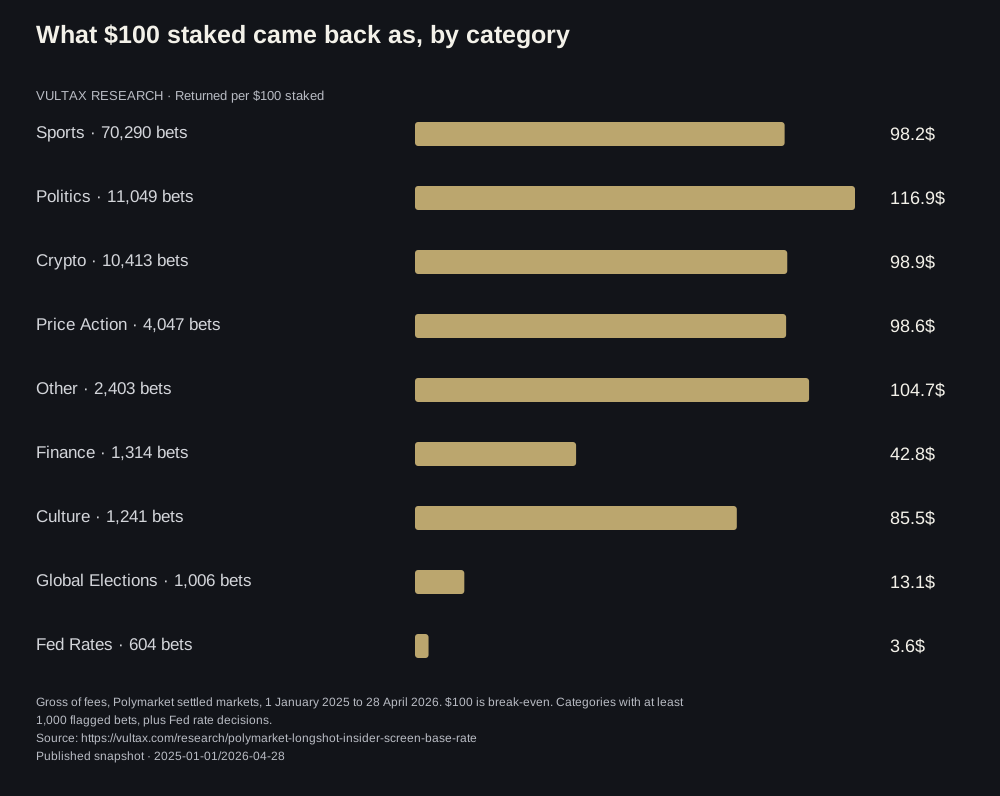
Politics is where the bet type paid: $140.9M over 11,049 bets by 5,111 wallets, won 23.61% of the time against an average price of 19.66¢, for +16.87% gross and the same after fees. Culture returned −14.49%, Sci-Tech −26.29% and Finance −57.21%. The two subjects the market prices most confidently lost almost everything staked against them: 2.15% of 604 Fed-rate long shots won at an average price of 12.07¢, and 5.67% of 1,006 global-election long shots at 17.66¢.
Below a few hundred bets a category's return is a handful of resolutions rather than a rate: the 713 bets tagged World returned +105.67% and the 626 tagged Romania +69.39%, both on a small number of large winners. Categories are the market's own tag as the tape records it and each bet carries exactly one, so the Soccer and Games rows below sit beside Sports rather than inside it. The table covers every category with at least 600 flagged bets; all 219 are in the data file.
What $100 staked came back as, by category
Gross of fees, Polymarket settled markets, 1 January 2025 to 28 April 2026. $100 is break-even. Categories with at least 1,000 flagged bets, plus Fed rate decisions.
Chart: Vultax Research
Show the numbers
| Category | Returned per $100 staked |
|---|---|
| Sports · 70,290 bets | $98.2 |
| Politics · 11,049 bets | $116.9 |
| Crypto · 10,413 bets | $98.9 |
| Price Action · 4,047 bets | $98.6 |
| Other · 2,403 bets | $104.7 |
| Finance · 1,314 bets | $42.8 |
| Culture · 1,241 bets | $85.5 |
| Global Elections · 1,006 bets | $13.1 |
| Fed Rates · 604 bets | $3.6 |
| Category | Bets | Wallets | Won | Average price paid | Staked | Gross return | After fees |
|---|---|---|---|---|---|---|---|
| All flagged bets | 113,863 | 17,858 | 24.37% | 23.01¢ | $1.24bn | −3.67% | −4.33% |
| Sports | 70,290 | 7,081 | 25.54% | 24.48¢ | $764.0M | −1.77% | −2.70% |
| Politics | 11,049 | 5,111 | 23.61% | 19.66¢ | $140.9M | +16.87% | +16.87% |
| Crypto | 10,413 | 2,734 | 23.85% | 21.72¢ | $92.4M | −1.06% | −1.44% |
| Price Action | 4,047 | 679 | 22.93% | 21.69¢ | $18.5M | −1.38% | −3.71% |
| Other | 2,403 | 1,262 | 23.55% | 21.90¢ | $24.9M | +4.74% | +4.46% |
| Finance | 1,314 | 908 | 15.68% | 21.89¢ | $17.8M | −57.21% | −57.80% |
| Culture | 1,241 | 860 | 21.19% | 17.62¢ | $13.3M | −14.49% | −14.53% |
| Global Elections | 1,006 | 773 | 5.67% | 17.66¢ | $19.8M | −86.94% | −86.94% |
| Bitcoin | 832 | 202 | 25.12% | 23.76¢ | $6.3M | −6.17% | −6.25% |
| Sci-Tech | 714 | 535 | 19.05% | 21.76¢ | $6.8M | −26.29% | −26.30% |
| World | 713 | 513 | 46.28% | 22.97¢ | $10.9M | +105.67% | +105.67% |
| Soccer | 662 | 376 | 25.68% | 22.54¢ | $7.5M | +22.08% | +22.06% |
| Games | 631 | 252 | 26.47% | 25.53¢ | $6.2M | +10.19% | +9.05% |
| Romania | 626 | 405 | 43.61% | 25.12¢ | $7.9M | +69.39% | +69.39% |
| Fed Rates | 604 | 429 | 2.15% | 12.07¢ | $10.8M | −96.44% | −96.44% |
Download table figures:CSVJSON with sources
Download chart figures:CSVJSON with sourcesSVG chart
Winning more often than the price implies, and still losing money
Across the whole screen the win rate, 24.37%, is slightly above the average price paid, 23.01¢ — 1.36 points of apparent edge — and the money still went backwards. Both are true at once because they are weighted differently: the win rate counts each bet once, and the return weights each bet by its stake. The large bets did worse than the small ones.
By category the gap runs both ways. Sports won 25.54% at 24.48¢, about a point of edge, and lost 1.77% of its stake. Politics won 23.61% at 19.66¢, four points of edge, and returned +16.87%. Finance won 15.68% at 21.89¢ and lost 57.21%. Culture is the clearest case of the two weightings disagreeing: it won 21.19% of its bets at an average of 17.62¢, three and a half points of edge per bet, and still lost 14.49% of the $13.3M staked. The extreme case is Fed rate decisions, where an average price of 12.07¢ was itself generous: 2.15% of those bets won.
That is the shape of a market that prices long shots roughly right and occasionally, in one category, does not. It is also why a win rate quoted on its own says nothing: 24% is excellent at 12 cents and poor at 30.
Share of flagged bets that won, against the price the market charged
Polymarket settled markets, 1 January 2025 to 28 April 2026. The four categories with more than 4,000 flagged bets, plus the two subjects the market priced most confidently.
- Bets that won
- Average price paid
Chart: Vultax Research
Show the numbers
| Category | Bets that won | Average price paid |
|---|---|---|
| Sports | 26% | 24% |
| Politics | 24% | 20% |
| Crypto | 24% | 22% |
| Price Action | 23% | 22% |
| Global Elections | 5.7% | 18% |
| Fed Rates | 2.1% | 12% |
Download chart figures:CSVJSON with sources
Perfect records against chance
33 of the 4,966 wallets with three or more qualifying bets won every one of them. The question a base rate lets you ask is how many you would expect if nothing but the market's own prices were at work.
Take each wallet's qualifying bets and assume each wins with the probability the market gave it, which is its own average entry price. Multiply those probabilities together and you have the chance that wallet goes perfect; add the result across all 4,966 wallets and you have the number of perfect records chance produces. That number is 18.5. Observed is 33: 1.79 times chance. Held instead against the flat 24.37% platform win rate, the expectation is 20.4.
Where the records sit matters more than the ratio. 32 of the 33 come from wallets that placed three or four qualifying bets, the band where chance manufactures perfect records; 18.02 were expected there. One came from the 5-to-9 band against 0.45 expected. In the 10-to-24 band, 890 wallets, none is perfect and none was expected to be, and the best record there is 70%. Among the 753 wallets with 25 or more, the best is 48%. A run that reflects something real should survive a longer sample. None of these reaches one.
The 33 are not nothing: 106 bets between them, $3.53 million of gross profit, a median wallet age of 7.3 days at the first qualifying bet and a median of 18.5 days still trading after the last one. Three of the 33 have an age that cannot be trusted, for the reason set out further down. They are a reasonable place to start asking questions. They are not, by themselves, an answer.
| Qualifying bets placed | Wallets | Perfect records | Expected by chance | Observed ÷ expected |
|---|---|---|---|---|
| 3 to 4 | 1,901 | 32 | 18.02 | 1.78 |
| 5 to 9 | 1,422 | 1 | 0.45 | 2.22 |
| 10 to 24 | 890 | 0 | 0.00 | — |
| 25 or more | 753 | 0 | 0.00 | — |
| All wallets with 3 or more | 4,966 | 33 | 18.50 | 1.79 |
Download table figures:CSVJSON with sources
What the success-rate filter actually selects
The bet rule is only the first half of the published screen. The second half is a wallet filter: keep the wallets that won more than 75% of their qualifying bets and concentrated on a small number of markets and topics. Run that filter on this reproduction exactly as written, with no minimum number of bets, and 2,070 wallets come back, holding 2,325 qualifying bets, $19.06 million staked and $58.67 million of gross profit. Those are excellent-looking numbers.
They are also almost entirely an artefact of how few bets each wallet placed. 1,888 of the 2,070 wallets — 91.2% — placed exactly one qualifying bet and won it, which scores as a 100% success rate. 2,026 of them, 97.9%, placed one or two. Only 44 wallets in the whole platform cleared 75% over three or more qualifying bets, and only 12 over five or more. Adding a concentration condition changes almost nothing: requiring three or fewer distinct categories still leaves 2,068 of the 2,070.
This is the arithmetic every outcome-conditioned screen has to answer. At a 24.37% base rate, one qualifying bet in four wins; among 17,858 wallets that is thousands of one-for-one records before anybody has done anything unusual. The filter is not wrong to start there — it is a way of narrowing a very large tape to something a person can look at. It is a starting list, and its size tells you how much work is left rather than how much has been found.
| Qualifying bets placed | Wallets over a 75% success rate | Their bets | Gross profit |
|---|---|---|---|
| 1 | 1,888 | 1,888 | +$46.75M |
| 2 | 138 | 276 | +$6.76M |
| 3 to 4 | 32 | 101 | +$3.21M |
| 5 to 9 | 12 | 60 | +$1.96M |
| 10 or more | 0 | 0 | — |
| All | 2,070 | 2,325 | +$58.67M |
Download table figures:CSVJSON with sources
The wallets that appeared and immediately bet big
A separate signature, reported alongside the screen, is a wallet created shortly before the trade. Vultax holds a first-seen date for all 2,404,822 wallets that appear on either side of a fill in the window, and 14,733 of the 17,858 flagged wallets have one that can be used; the other 3,125 are covered in the limits below.
Sorted by how old the wallet was when it placed its first qualifying bet, the youngest band is the worst. 4,860 wallets that qualified within 24 hours of their first-ever fill placed 27,910 bets, staked $381.3 million and lost $19.58 million: −5.14%. 23.50% of those bets won, and the average wallet in that band won 18.31% of its own. The 24-to-48-hour band lost 7.12%. The only band that finished ahead was two to seven days old, and it returned +0.26% on $130.8 million.
So the "created hours before trading" filter, applied on its own across the whole platform, selects a population that loses more than the average flagged bettor does. It is a real property of some wallets that turned out to know something. It is also the ordinary signature of a new account taking one big swing.
| Wallet age at its first qualifying bet | Wallets | Bets | Bets that won | Staked | Gross profit | Return |
|---|---|---|---|---|---|---|
| Up to 24 hours | 4,860 | 27,910 | 23.50% | $381.3M | −$19.58M | −5.14% |
| 24 to 48 hours | 633 | 5,825 | 25.46% | $65.8M | −$4.68M | −7.12% |
| 2 to 7 days | 1,745 | 12,432 | 24.59% | $130.8M | +$0.34M | +0.26% |
| 7 to 30 days | 3,012 | 21,256 | 24.95% | $196.5M | −$2.53M | −1.29% |
| More than 30 days | 4,483 | 22,795 | 24.42% | $208.8M | −$8.79M | −4.21% |
Download table figures:CSVJSON with sources
How new is a new wallet: 134 of 250 first seen in the record's first month had traded before
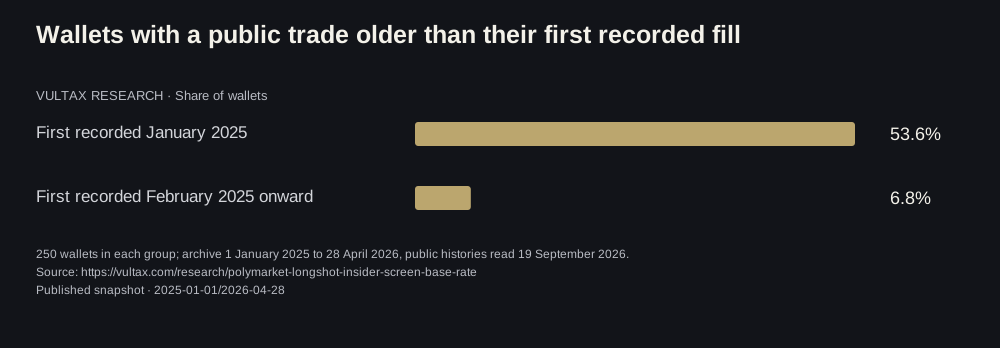
A first-seen date is where a record starts watching a wallet, which is not always where the wallet started. Vultax checked 500 wallets from this record against the oldest trade Polymarket's public activity API returns for them. Of 250 first seen in January 2025, the month the record begins, 134 (53.6%) had an older public trade, by a median of 43 days. Of 250 first seen from February 2025 onward, 17 (6.8%) had.
The pattern is exact. All 151 older trades date from before 1 January 2025, and the other 349 wallets matched the record to the second. Inside the window a first-seen date is reliable; at its start it is wrong more often than right. The 17 later wallets are returning traders: each traded in 2024, was absent from the first month or more of the record, and came back, a median of 146 days after its oldest trade.
For the bands above, that means a wallet counted as hours old can be a 2024 account returning, at a rate of about one in fifteen away from the start of the record. It makes the youngest band look newer than it is; it does not rescue its return. An alert that calls a wallet fresh can settle the question with one request: the activity endpoint filtered to trades, oldest first, limit one.
Wallets with a public trade older than their first recorded fill
250 wallets in each group; archive 1 January 2025 to 28 April 2026, public histories read 19 September 2026.
Chart: Vultax Research
Show the numbers
| Category | Share of wallets |
|---|---|
| First recorded January 2025 | 54% |
| First recorded February 2025 onward | 6.8% |
| First recorded fill | Wallets checked | Had an older public trade | Share | 95% interval | Median head start |
|---|---|---|---|---|---|
| January 2025 | 250 | 134 | 53.6% | 47.4–59.7% | 43 days |
| February 2025 onward | 250 | 17 | 6.8% | 4.3–10.6% | 146 days |
Download table figures:CSVJSON with sources
Download chart figures:CSVJSON with sourcesSVG chart
What a screen can and cannot show
A screen is a filter, not a finding. This one selects on price, size and speed — three things visible to anyone reading the tape — and then the outcome does the rest of the work. Sorting the result by win rate guarantees a profitable top group whatever the population: among the 4,966 wallets with three or more qualifying bets, every band above a 25% win rate made $126.7 million between them, and the band below it lost $143.2 million. The wallets at the top of that sort are the wallets that won. That is what the sort is for.
Wallet age is an upper bound, not a birth date. Vultax's record starts on 1 January 2025, so a wallet that traded in 2023 and again in 2025 looks new. A stratified sample of 500 wallets checked against Polymarket's own public activity endpoint, 500 of 500 resolved, put the error at 53.6% for wallets first seen before February 2025 and 8.4% for wallets first seen after, or about 17.1% of all wallets once weighted to the population. 3,125 of the 17,858 flagged wallets, 17.5%, fall in the unreliable cohort and are left out of every age figure on this page.
Two things the screen cannot see at all. It counts a position the same way whether the wallet crossed the spread to get it or was sitting on the other side of somebody else's order, so a market maker filled passively at 30 cents looks identical to a buyer who chased the price. And a wallet is a Polymarket proxy address, not a person: one operator running ten wallets counts as ten wallets, and the address clustering that would fix that is not part of this measurement. Every claim of the form "N wallets did X" inherits that.
The appear, win, withdraw pattern cannot be completed from this record either. It is a record of fills — maker, taker, price, size, fee — with no deposits, withdrawals or redemptions in it. What is visible is dormancy: whether a wallet stopped trading after its last flagged bet. And the plainest limit of all is that a public screen is not the instrument that matters most. The venue runs its own surveillance and refers accounts, and the CFTC's February 2026 advisory names insider trading on event contracts as conduct it polices on any designated contract market. Those parties can see identity, funding and intent. A screen on the public tape can see three numbers.
| Win-rate band, wallets with 3 or more qualifying bets | Wallets | Bets | Gross profit |
|---|---|---|---|
| 90% or better | 33 | 106 | +$3.53M |
| 75% to 90% | 50 | 219 | +$4.39M |
| 50% to 75% | 458 | 2,335 | +$28.20M |
| 25% to 50% | 2,056 | 50,495 | +$90.54M |
| Under 25% | 2,369 | 45,194 | −$143.15M |
Download table figures:CSVJSON with sources
Context from elsewhere
The screen reproduced here is published work. In August 2026 the Anti-Corruption Data Collective released “Classifying Insider Trading Risk: Analyzing the Longshot Betting Ecosystem on Polymarket”, which examined settled Polymarket markets through 5 May 2026, defined a long-shot bet as more than $2,500 wagered at 35 cents or less, and sorted the platform’s long-shot wallets into four groups. 556 of them — the group it called Orcas — met a profile of betting in a small number of markets and on very few topics with a success rate above 75%. Reuters, which reported the work first, described 152 of those wallets as concentrated on military and defence markets, winning about $8 million at an average 97.2% win rate against roughly 52% for long-shot bets in those markets generally.
CNN reported the following day that a senior Polymarket official said the company had referred dozens of accounts showing signs of military insider trading to the Department of Justice, referrals that predated the report, and that its internal surveillance monitors around 150 further signals and trading patterns. Polymarket publishes a market-integrity policy that prohibits trading on confidential information and describes real-time surveillance and referral to law enforcement. Polymarket itself has not been accused of wrongdoing.
Bloomberg Businessweek covered the same question in July 2026, reviewing about 34,000 Polymarket transactions flagged by the analytics platform Polysights between August 2025 and June 2026. It reported that 57% of the flagged wallets had been created less than 24 hours before their flagged trades, and that 38 connected wallets betting across 90 markets tied to Iran and Venezuela won 98% of them for about $1.6 million. It noted that a flag does not prove wrongdoing.
In September 2026 the Wall Street Journal described a different shape of the same problem. Wallet clustering by Bubblemaps linked 19 Polymarket accounts that went 41 for 42 on earnings bets covering roughly 18 companies audited by KPMG, beginning in November 2025, for about $22,000 of gains. KPMG said it has zero tolerance for the misuse of non-public client information, and Bubblemaps said clustering on its own does not prove insider trading. That case is the argument for address clustering as a technique, and clustering is exactly the piece this measurement does not have.
The academic version is “From Iran to Taylor Swift: Informed Trading in Prediction Markets” by Joshua Mitts of Columbia Law School and Moran Ofir, an SSRN working paper from March 2026. Screening every Polymarket contract from February 2024 to February 2026 with a composite score built from bet size, profitability, pre-event timing and directional concentration, it reports 210,718 suspicious wallet-market pairs, a 69.9% win rate more than 60 standard deviations above a permutation null, and roughly $143 million of anomalous profit. A later working paper sets out the limitation that this study meets from the other side: a score with profitability in it can only be computed once the market has resolved, and it does not separate skill from luck by itself.
Method and limits
Window: 1 January 2025 to 28 April 2026, 714,691,643 Polymarket fills, settled markets only, 662,215 of them. A bet is one wallet-market-side episode whose rolling one-hour stake reached $2,500 over fills where the side held was priced at 35 cents or less; profit and loss covers that episode's long-shot fills only. Stake is shares multiplied by entry price, and gross profit is winning shares minus stake. Groups whose total long-shot stake never reaches $2,500 cannot contain a qualifying window and are removed before the rolling sum is taken.
Two differences from the published version are worth stating, because they move the count. That version says more than $2,500; this reproduction uses $2,500 or more, which is how the first report of it rendered the rule. And this record runs from 1 January 2025 to 28 April 2026 and includes the multi-outcome negative-risk markets that a binary-only tape leaves out, where the published version covered settled markets through 5 May 2026. The two populations are not the same set of bets and their counts should not be expected to match; what carries across is the bet type and the base rate for it.
Fees are the tape's own fee field, charged entirely to the taker, which is how Polymarket charges them; makers pay none. Gross is the headline because it is the number a reported win rate implicitly quotes, and net is the sensitivity check. Categories are the market's own tag as the tape records it, one per bet, so Soccer and Games are rows beside Sports rather than parts of it. Returns are stake-weighted; win rates count each bet once, which is why a category can win more often than its price implies and still lose money.
The window closes on 28 April 2026 and says nothing about the months since. Wallet identity is an address, not a person, and no address is published here. Vultax's calibration study measures the same favourite-longshot effect from the price side, and the trading-cadence study describes the population these wallets sit inside.
Nothing here is a recommendation to trade, and no wallet selected by this screen is being accused of anything. Challenge a figure at [email protected]; material changes are logged in the changelog.
The wallet-age check fixed its sample on 16 September 2026: wallets in each group ordered by hash, the first 250 with at least five fills taken, and each compared with its oldest public trade on 19 September. The two groups are reported side by side and are not weighted up to a platform-wide rate. Download all 500 rows, the summary figures, the method notes and the reproduction bundle.
Downloads contain the published study figures. Changing market widgets are separate. Use Vultax research with an AI assistant. Press note.
Questions this page answers
- Do wallets flagged by a Polymarket insider screen actually win?
- As a population, no. The bet rule — more than $2,500 wagered inside an hour on an outcome at 35 cents or less — catches 113,863 bets by 17,858 wallets across Polymarket's settled markets between January 2025 and April 2026. 24.37% won, against an average entry price of 23.01 cents, and the stake-weighted return was −3.67% before fees. Individual wallets inside that population did very well. The population lost $45.5 million.
- What is the $2,500-in-an-hour Polymarket screen?
- Two rules in sequence. The first defines a qualifying bet: a wallet's cumulative wager on one side of one market passes $2,500 within an hour while that side is priced at 35 cents or less. The second keeps the wallets that won more than 75% of their qualifying bets and concentrated on a few markets and topics. It selects on price, size, speed and outcome only, and it cannot see who a wallet belongs to, where the money came from, or whether the wallet chased the price or was filled passively.
- How many Polymarket wallets pass a 75% success rate on long-shot bets?
- 2,070 across the whole platform between January 2025 and April 2026, holding 2,325 qualifying bets and $58.67 million of gross profit. 1,888 of those 2,070 placed exactly one qualifying bet and won it, and 2,026 placed one or two. Only 44 wallets cleared 75% over three or more qualifying bets, and only 12 over five or more.
- Is a perfect Polymarket win streak proof of insider trading?
- Not on its own. 33 wallets won every one of three or more qualifying bets; chance at the market's own prices predicts 18.5. Thirty-two of those 33 placed only three or four bets, the band where chance manufactures perfect records, and no wallet with ten or more qualifying bets has one — the best record among the 890 wallets with 10 to 24 is 70%. A streak is a reason to ask a question, not an answer to it.
- Do new Polymarket wallets that bet big on long shots make money?
- On average they lose more than the rest. 4,860 wallets whose first qualifying bet came within 24 hours of their first-ever trade staked $381.3 million across 27,910 bets and lost $19.58 million, a return of −5.14% — the worst of the five age bands measured. Wallet age here is an upper bound, because the record starts on 1 January 2025 and a wallet that traded earlier looks new.
- How do you check how old a Polymarket wallet is?
- Ask Polymarket's public activity API for the wallet's trades sorted oldest first, limit one. In Vultax's check of 500 wallets that date matched a fill archive to the second for 349 and was older for 151, every one of which had traded before the archive began on 1 January 2025.
- Does a fresh wallet on Polymarket mean a new trader?
- Not reliably. Of 250 wallets first recorded in the month a dataset began, 134 had older public trades, by a median of 43 days. Away from the start of the data the rate was 17 of 250. A first trade also says nothing about who controls the wallet or when it was funded.
Sources and evidence
- Anti-Corruption Data Collective — Classifying Insider Trading Risk: Analyzing the Longshot Betting Ecosystem on Polymarket
August 2026. Defines a long-shot bet as "more than $2500 wagered at 35 cents or less" and the wallet profile as betting in a small number of markets and on very few topics with a success rate above 75%. Settled markets through 5 May 2026; 12,355 long-shot wallets classified, 556 of them matching the profile.
- Reuters — More than 150 Polymarket wallets may have traded on military secrets, research finds
20 August 2026. First report of the study; renders the threshold as at least $2,500 placed cumulatively in an hour or less at odds of 35% or lower. 152 wallets concentrated on military and defence markets, about $8 million won at an average 97.2% win rate against roughly 52% for long-shot bets in those markets generally.
- CNN — Polymarket referred dozens of possible military insider trading cases to DOJ, source says
21 August 2026. A senior Polymarket official said the referrals predated the report and that internal surveillance monitors around 150 further signals and trading patterns. Polymarket has not been accused of wrongdoing; the Department of Justice did not comment.
- Polymarket — Market Integrity Policy
The venue's own policy: trading on stolen or confidential information and trading by anyone positioned to influence an outcome are prohibited; real-time surveillance and referral to law enforcement are described.
- Bloomberg Businessweek — Polymarket and Kalshi Grapple With a New Era of Insider Traders
20 July 2026. About 34,000 Polymarket transactions flagged by Polysights between August 2025 and June 2026; 57% of flagged wallets created less than 24 hours before their flagged trades; 38 connected wallets across 90 Iran and Venezuela markets won 98% of them for about $1.6 million. A flag is not presented as proof of wrongdoing.
- The Wall Street Journal — Cluster of Polymarket Accounts Won Big on Companies Audited by KPMG
11 September 2026. Bubblemaps clustering linked 19 accounts that went 41 for 42 on earnings bets across roughly 18 KPMG audit clients from November 2025, for about $22,000. KPMG cited zero tolerance for misuse of non-public client information; Bubblemaps said clustering alone does not prove insider trading.
- Mitts and Ofir — From Iran to Taylor Swift: Informed Trading in Prediction Markets
SSRN working paper, March 2026. Every Polymarket contract from February 2024 to February 2026 scored on bet size, profitability, pre-event timing and directional concentration: 210,718 suspicious wallet-market pairs, a 69.9% win rate more than 60 standard deviations above a permutation null, about $143 million of anomalous profit.
- Nechepurenko — Per-Market Information Leakage and Order-Flow Skill
May 2026. Sets out the limitation of an outcome-conditioned score: profitability is only known at resolution, so the screen gives no real-time signal and does not separate skill from luck on its own.
- CFTC — Enforcement Division issues Prediction Markets Advisory
25 February 2026. Names insider trading, fraud and manipulation, wash sales and pre-arranged trading as conduct the Commission polices on any designated contract market.
- Polymarket trading fees
"Makers are never charged fees. Only takers pay fees." The basis for charging the tape's fee field entirely to the taker in the net-of-fee figures.
- Polymarket Data API — wallet activity
Used to calibrate the first-seen dates: a stratified sample of 500 wallets was checked against the earliest activity record the venue holds, and 500 of 500 resolved.
- Vultax: Polymarket prices tested against 6,776 resolved markets
The favourite-longshot effect measured from the price side rather than the wallet side
- Vultax: 1.6% of Polymarket wallets never sleep
The wallet population these flagged wallets sit inside, measured by cadence
- Vultax: where Polymarket profits go
Realised profit and loss per wallet, and how little of it persists
- Vultax methodology
How Vultax measures, and what it does not claim
- Polymarket activity API documentation
Oldest public trade per wallet; read 19 September 2026.
- Vultax wallet-age check, 500 wallets
First recorded fill against oldest public trade; addresses replaced by sample numbers.
Figures describe Polymarket fills between 1 January 2025 and 28 April 2026 in markets that had settled by the end of that window. A screen is a filter on public trading records, not a finding about any person, and no wallet it selects is accused of anything here. Not a recommendation to trade, and not financial advice.
Watch this measurement live in Vultax.
Every tracked Polymarket wallet with its realised profit, win rate and activity, ranked from Vultax's own record of fills.
Get the data behind this study.
Win rate, average entry price, stake and return for the $2,500-in-an-hour long-shot screen across all 219 Polymarket categories, with the same measurement and no size gate, 1 January 2025 to 28 April 2026 (CSV), as a CSV, plus one email when the next study publishes.
Continue reading
1.6% of Polymarket Wallets Never Sleep. They Made 58% of All Trades.
Hourly activity for 130,346 Polymarket wallets over 12 days in August and September 2026: 2,080 wallets were active in every hour of the clock and filled 58.4% of 9.82 million trades. The ten busiest wallets alone filled one trade in five. Half of all wallets traded on a single day.
How Polymarket Settles: 110,576 Markets, a Median of 2.2 Hours, and 89 Disputes
Vultax measured every Polymarket market that ended between 15 August and 10 September 2026. Most settled within hours of their scheduled end, 37% closed early because the result was already known, and 89 were disputed, rare overall but most common on geopolitics and big markets.
Polymarket Copy Trading: Following 30 Seconds Late Cost 1.43¢ a Share, Before Fees
What copying a Polymarket trader costs, measured and worked. Behind buys by the 1,000 most profitable wallets, a follower 30 seconds late paid 1.43¢ a share more in event markets; fees and fill put a copier of a $50 crypto trade down about 6% before the market moves. Four tools compared.