How Polymarket Makes Money: $46.6 Million in Taker Fees in Four Months
Polymarket charged no trading fees in 2025. From 1 January to 28 April 2026 takers on its international exchange paid an estimated $46.6 million, $28.4 million of it in April, two thirds on crypto markets. Fees by month and category, the schedule behind them and its other revenue.
Taker fees, January to April 2026
$0.046.6M
Estimated fill by fill on Polymarket's international exchange, 1 January to 28 April 2026, at the schedule in force; makers paid none. 2025: $0 on $9.69 billion traded.
- Paid in April 2026 alone
- $0.028.4M
- 28 days, after fees reached almost every category on 30 March; about $1.0 million a day.
- Share paid on crypto markets
- 067%
- $31.3M of $46.6M; sports $14.4M; every other category together under $1M.
- Fee on fee-paying volume
- 0.000.91%
- Of $5.11 billion traded in fee-enabled markets; across all $14.96 billion traded in the period, 0.31%.
The short answer
Polymarket makes its money from a fee on the taker, the side of a trade that fills an order already resting in the book. Until January 2026 it charged nothing: its own documentation said in September 2025 that it did not charge "any type of trading fees". Fees started on 5 January on 15-minute crypto markets and by 30 March covered almost every category.
Between 1 January and 28 April 2026, takers on Polymarket's international exchange paid $46.6 million. $28.4 million of it fell in the last 28 days, once the fee reached sports, politics and the rest of the catalogue. Makers pay nothing, and part of every taker fee goes back to them as rebates.
Fees by month
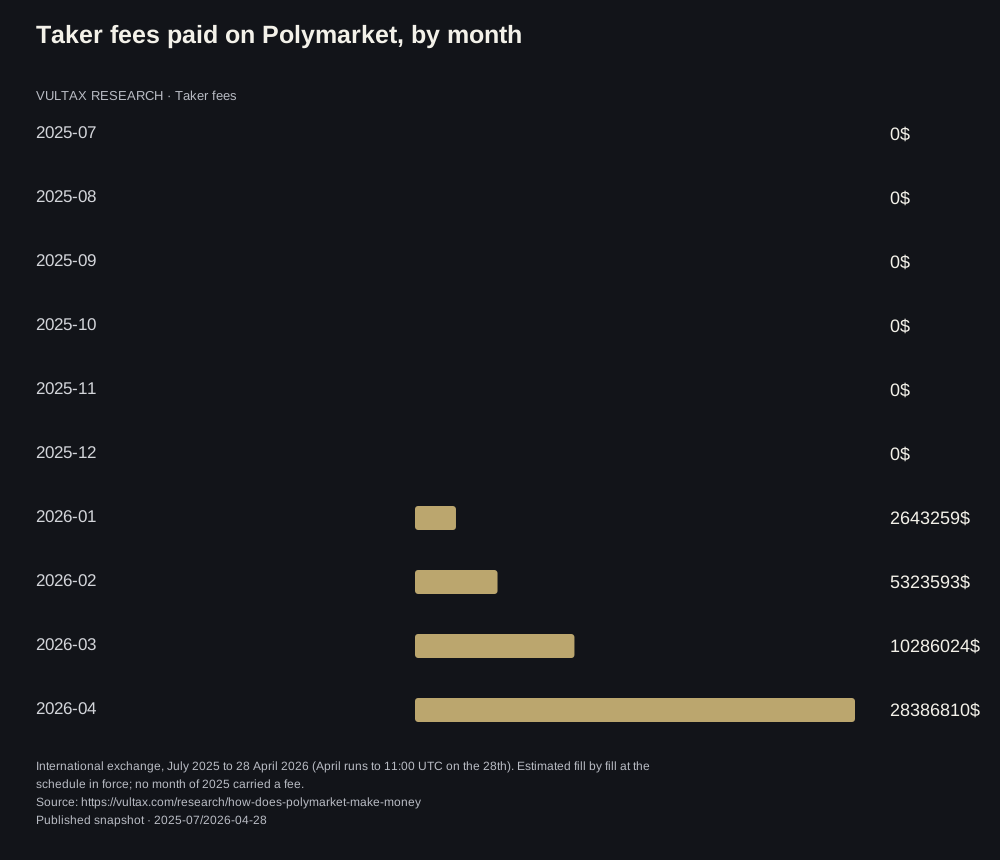
No month of 2025 carried a fee. January 2026 brought $2.6 million, all of it from markets on the 15-minute crypto schedule; February $5.3 million; March $10.3 million; and April, to 11:00 UTC on the 28th, $28.4 million.
Most of the growth was coverage. The share of trading that paid a fee went from 12.0% in January to 65.7% in April. The fee on that volume held between 0.67% and 0.72% of the dollars traded until March, then rose to 1.16% in April under the new category rates.
Taker fees paid on Polymarket, by month
International exchange, July 2025 to 28 April 2026 (April runs to 11:00 UTC on the 28th). Estimated fill by fill at the schedule in force; no month of 2025 carried a fee.
Chart: Vultax Research
Show the numbers
| Category | Taker fees |
|---|---|
| 2025-07 | $0 |
| 2025-08 | $0 |
| 2025-09 | $0 |
| 2025-10 | $0 |
| 2025-11 | $0 |
| 2025-12 | $0 |
| 2026-01 | $2.6M |
| 2026-02 | $5.3M |
| 2026-03 | $10.3M |
| 2026-04 | $28.4M |
Download chart figures:CSVJSON with sourcesSVG chart
Where the fees came from
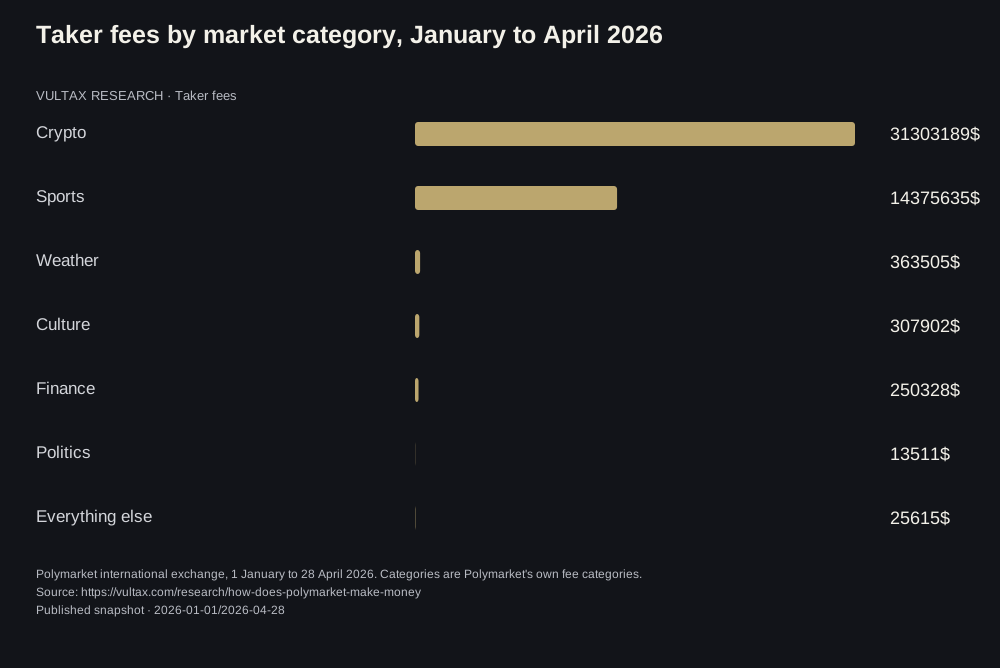
Crypto paid two thirds of it, $31.3 million. Its short up-or-down markets carried the steepest curve of the early schedule, 1.56% of the trade at a 50% price, from the first week of January. Sports paid $14.4 million, and by April it had nearly caught up: $13.3 million against crypto's $14.1 million that month.
Politics traded $1.75 billion in the period and paid $14K. Its fee started on 30 March and applied only to markets created after that date, and most of the big political markets were older. For the same two reasons, a late start and older markets, 73% of sports volume in the period paid no fee.
Taker fees by market category, January to April 2026
Polymarket international exchange, 1 January to 28 April 2026. Categories are Polymarket's own fee categories.
Chart: Vultax Research
Show the numbers
| Category | Taker fees |
|---|---|
| Crypto | $31.3M |
| Sports | $14.4M |
| Weather | $364K |
| Culture | $308K |
| Finance | $250K |
| Politics | $14K |
| Everything else | $26K |
| Category | Taker fees | Share of fees | Traded | Fee on fee-paying volume |
|---|---|---|---|---|
| Crypto | $31.3M | 67.1% | $4.32bn | 0.97% |
| Sports | $14.4M | 30.8% | $6.38bn | 0.83% |
| Weather | $364K | 0.8% | $167M | 0.45% |
| Culture | $308K | 0.7% | $427M | 0.84% |
| Finance | $250K | 0.5% | $251M | 0.67% |
| Politics | $14K | under 0.1% | $1.75bn | 0.28% |
| Tech | $12K | under 0.1% | $81M | 0.70% |
| Economics | $5K | under 0.1% | $400M | 0.75% |
| Mentions | $5K | under 0.1% | $0.8M | 0.56% |
| Other / General | $4K | under 0.1% | $406M | 0.52% |
| Geopolitics | $0 | none | $761M | fee-free |
Download table figures:CSVJSON with sources
Download chart figures:CSVJSON with sourcesSVG chart
How the fee is set
Since April 2026 the fee is C × rate × p × (1 − p): the shares traded, times the category's rate, times the price, times one minus the price. It is largest at 50¢ and shrinks toward either end. At the rates read on 25 September 2026, a taker who buys 100 shares at 50¢ in a sports market pays $1.25. Because the fee falls more slowly than the price, it is a larger share of the stake on long shots: at 10¢ a crypto taker pays 6.3% of what they spend. The Vultax fee calculator prices any trade.
A new rate applied only to markets created after it took effect, so each market carries its own schedule and older markets kept theirs.
| Date | What changed |
|---|---|
| Until January 2026 | No trading, deposit or withdrawal fees on any market |
| 5 January 2026 | Taker fee on 15-minute crypto markets, peaking at 1.56% at a 50% price; it funds daily rebates to makers |
| 12 February 2026 | 5-minute crypto markets launch on the same fee curve |
| 18 February 2026 | Taker fee on college basketball (NCAAB) and Serie A markets, peaking at 0.44% |
| 6 March 2026 | All new crypto markets, including hourly, 4-hour, daily and weekly |
| 30 March 2026 | Almost every category: crypto, sports, finance, politics, economics, culture, weather, tech, mentions and other; geopolitics stays fee-free |
| 28 April 2026 | New exchange contracts: the fee is set when an order matches rather than signed into it |
| 28 May 2026 | Tiered rebates for takers begin |
| 10 July 2026 | Sports rate raised from 0.03 to 0.05 |
| 25 September 2026 | Rates: crypto 0.07; sports, economics, culture, weather and other 0.05; politics, finance, tech and mentions 0.04; geopolitics 0 |
Download table figures:CSVJSON with sources
What Polymarket keeps
Makers pay nothing and receive part of the taker's fee as a rebate: 20% in crypto markets and 25% elsewhere on the April schedule, and 15% in sports since July. On those documented shares, $36.5 million of the $46.6 million stayed with Polymarket; the rebate payouts themselves are not published. Apps that route orders can add a builder fee of their own on top, and that fee goes to the builder.
Context from elsewhere
Polymarket US is a separate exchange, registered with the CFTC, which Polymarket entered by buying QCEX for $112 million in July 2025. Its fee has risen in steps: a taker fee of 1 basis point of premium, raised to 10 in January 2026, then a price-weighted formula whose taker coefficient went from 0.06 to 0.0695 in September 2026, according to its filings with the CFTC. Its trading is not in the figures above.
Data is another line. ICE, the owner of the New York Stock Exchange, agreed to invest up to $2 billion and to distribute Polymarket's event data, and in February 2026 launched a Polymarket signals and sentiment product for institutions. Polymarket's partnerships with X and Dow Jones put its prices in front of their audiences without disclosed financial terms, and on 3 September 2026 it opened a perpetual-futures exchange for users outside the U.S. The company told CNBC in June 2026 that its annualized revenue was "well above $1 billion".
Method and limits
The trades are the public Polymarket-v1 dataset by Boka Qin and Rui Yang: 714,691,643 fills on Polymarket's international exchange from 1 January 2025 to 11:00 UTC on 28 April 2026, when the exchange moved to new contracts. For each fill Vultax applied the fee Polymarket charged at the time: the market's own fee type, the formula and rate in force on the fill's date, including the 30–31 March switchover, and only where the maker's order carried a fee, which marks a fee-enabled market.
The estimate was checked against the fees Polymarket's contracts actually collected on-chain, the taker's fee net of the fee module's refund, in seven windows between 20 January and 27 April 2026: $727,813 estimated against $724,786 collected, 0.4% apart and within 2.3% in every window.
The dataset's fee_usdc column is not a fee. It records the maker order's fee field, which Polymarket refunds in the same transaction; in the seven windows it came to between 9 and 26 times what takers paid. Polymarket US and trading after 28 April are not in these numbers.
Downloads contain the published study figures. Changing market widgets are separate. Use Vultax research with an AI assistant. Press note.
Questions this page answers
- How does Polymarket make money?
- Mainly from a fee on takers, the side of a trade that fills a resting order. It charged nothing until January 2026; from 1 January to 28 April 2026 takers on its international exchange paid about $46.6 million. It also runs a separately regulated U.S. exchange with its own fee, distributes data through ICE and opened a perpetual-futures exchange in September 2026.
- Does Polymarket charge trading fees?
- Yes, since January 2026, and on almost every category since 30 March 2026. Only takers pay; makers are never charged. Geopolitics and world-events markets are fee-free.
- How is the Polymarket taker fee calculated?
- Fee = shares × rate × price × (1 − price), with the rate set by the market's category: on 25 September 2026, 0.07 for crypto, 0.05 for sports, economics, culture, weather and other, and 0.04 for politics, finance, tech and mentions. 100 shares at 50¢ in a sports market cost $1.25 in fees.
- How much of Polymarket's fee revenue comes from crypto markets?
- Two thirds in January to April 2026: $31.3 million of $46.6 million. Sports markets paid $14.4 million, and every other category together less than $1 million.
- Who pays Polymarket's fees, makers or takers?
- Takers. Makers pay nothing and receive a share of taker fees as rebates: 20% in crypto markets, 15% in sports and 25% in other categories on 25 September 2026.
Sources and evidence
- Boka Qin and Rui Yang — Polymarket-v1 Database (TimeSeventeen)
Historical fills, CC BY 4.0; 714,691,643 fills, 1 January 2025 to 28 April 2026
- Polymarket — trading fees
Formula, category rates, fee-free geopolitics; read 2026-09-25
- Polymarket — changelog
Fee start on 15-minute crypto, NCAAB and Serie A, all crypto from 6 March, all categories from 30 March, sports 0.05 from 10 July
- Polymarket — fees page, September 2025 (Wayback Machine)
"Polymarket does not charge any type of fee"
- Polymarket — fees page, 22 April 2026 (Wayback Machine)
April schedule; "Makers are never charged fees. Only takers pay fees."
- Polymarket — maker rebates
Rebates funded by taker fees
- Polymarket — taker rebates
Live from 28 May 2026
- Polymarket — builder fees
Builder fees stack on top of platform fees
- The Block — Polymarket adds taker fees to 15-minute crypto markets (Jan 2026)
First trading fees
- Polymarket — acquisition of QCEX for $112 million (Jul 2025)
QCX LLC and QC Clearing LLC
- Polymarket US — fee schedule notice (8 Jan 2026)
Taker fee from 1 to 10 basis points of premium
- Polymarket US — weekly notification (21 Sep 2026)
Taker coefficient from 0.06 to 0.0695
- ICE — Form 8-K exhibit on the Polymarket investment
Up to $2 billion; global distributor of Polymarket's event data
- ICE — Polymarket Signals and Sentiment launch (Feb 2026)
Institutional data product
- Polymarket and X — official partnership
Terms not disclosed
- Polymarket and Dow Jones — data partnership
No financial terms stated
- The Oracle by Polymarket — Inside Polymarket Perps
Launched 3 September 2026
- CNBC — Polymarket annualized revenue above $1 billion (26 Jun 2026)
Company-supplied run rate
Fee figures are Vultax estimates from public on-chain fills at Polymarket's published schedule, checked against fees collected on-chain; they are not Polymarket's reported revenue. Nothing here is financial advice.
Watch this measurement live in Vultax.
Live Polymarket markets, topics and traders in one screen, with Vultax analytics beside every price.
New studies, by email.
Measured, sourced, and sent once per study. No digests, no promotions.
Continue reading
How Polymarket Settles: 110,576 Markets, a Median of 2.2 Hours, and 89 Disputes
Vultax measured every Polymarket market that ended between 15 August and 10 September 2026. Most settled within hours of their scheduled end, 37% closed early because the result was already known, and 89 were disputed, rare overall but most common on geopolitics and big markets.
Polymarket's Up-or-Down Crypto Markets: 60% of Its Trades, Priced About Right, 1.6% Fee
Vultax counted 15.0 million Polymarket trades over 251 hours: 59.6% were up-or-down crypto bets, 379 wallets made most of them, and takers paid about 1.6% of notional on five-minute trades. In 2,497 markets checked against outcomes, Up won 50.2% and favourites won as often as priced.
Polymarket Had the September Fed Hike at 87.5%: Every 2026 FOMC Decision, Scored
Polymarket priced the 16 September 25 bp hike at 87.5% a day and an hour before the statement, a five-outcome Brier score of 0.029. The same record now follows the 27–28 October meeting, with prices locked 14 days, 7 days, 24 hours and 1 hour out.