Brazil Election 2026: Runoff Date, Polls, Odds and Results
Brazil votes again on 25 October. Follow the Lula–Flávio Bolsonaro runoff with dated polling, market odds and links to official TSE results.

Flávio Bolsonaro, first round
0.0047.03%
Share of valid votes, TSE, 99.99% of polling sections counted, 5 October 2026
- Luiz Inácio Lula da Silva, first round
- 0.0045.16%
- Share of valid votes on the same count
- Runoff day
- 25 Oct
- Sunday. Official results begin after 17:00 Brasília, 20:00 UTC
- Flávio Bolsonaro on Polymarket, 19 October
- 77¢
- Yes offer to win the presidency, as displayed on the market page
The runoff is on 25 October
Brazil's presidential election goes to a runoff between Luiz Inácio Lula da Silva and Flávio Bolsonaro on Sunday, 25 October 2026. As of this guide's check on 19 October, the second-round result has not been decided. The TSE results portal is the place to check the official count when voting ends.
The number beside a candidate's name needs a label. A poll measures reported voting intention among a sample. A market price describes a contract on who wins. The official count records votes already cast. This guide connects those three views, with the Brazil election room for current available market data.
What the first round decided
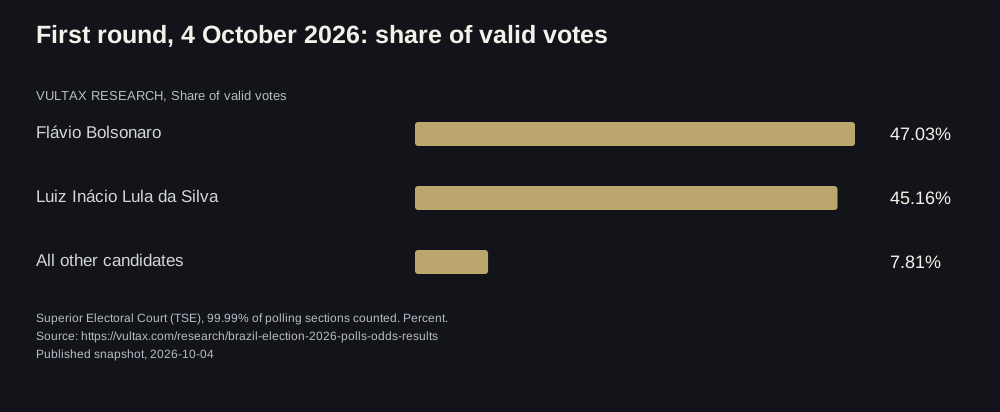
In its 5 October report, Brazil's Superior Electoral Court recorded Flávio Bolsonaro on 47.03% of valid votes and Lula on 45.16%, with 99.99% of polling sections counted at the stated cutoff. Those are first-round shares. Neither reached a majority, so the two advanced.
Finishing first on 4 October did not award the presidency. The runoff is a new vote between the remaining two candidates. Adding the first-round shares of eliminated candidates to one finalist assumes that their voters all move together and that turnout stays the same. Neither assumption is established by the first-round totals.
First round, 4 October 2026: share of valid votes
Superior Electoral Court (TSE), 99.99% of polling sections counted. Percent.
Blank and null ballots are outside the valid-vote denominator. The other candidates are summed, not listed.
Chart: Vultax Research
Show the numbers
| Category | Share of valid votes |
|---|---|
| Flávio Bolsonaro | 47% |
| Luiz Inácio Lula da Silva | 45% |
| All other candidates | 7.8% |
Download chart figures:CSVJSON with sourcesSVG chart
Three ways to follow the same race
Use each source for the question it can answer. A polling table is useful for comparing voting intention over time. A market screen is useful for seeing how a priced expectation changes. The electoral authority is the source for the result.
| You want to know | Start here | Read this label |
|---|---|---|
| Who leads in a survey? | Start herePolls versus odds | Read this labelFieldwork dates, sample, question and vote denominator |
| How are traders pricing the winner? | Start hereBrazil election room | Read this labelObservation time, contract rules, bid/ask and available depth |
| Who won the official vote? | Start hereTSE results portal | Read this labelRound, office, reporting progress and official status |
Download table figures:CSVJSON with sources
Which polls should you compare?
Begin with the pollster's own release and its fieldwork dates. Our polls-versus-odds explainer uses a named Datafolha survey to show why an all-response percentage changes when the denominator becomes valid votes. It also explains why neither figure is a win probability.
Compare national runoff questions with national runoff questions. A state poll, a first-round poll and a hypothetical matchup from months ago answer different questions. Check whether undecided respondents and blank or null responses are included. A release date alone does not tell you when respondents were interviewed.
The TSE's polling resources link to PesqEle registrations. Look for the registration number, commissioning party and methodology when checking a circulated image. A screenshot stripped of that context is a poor basis for comparing surveys.
What to inspect on a market screen
Read the contract question before reading the price. A market on the first-round leader, a market on the eventual president and a market on the victory margin have different conditions. A winning first-round position can coexist with an uncertain presidential race.
Then inspect the price's timestamp, the spread between bids and asks, and the depth available near that quote. A headline price does not promise that an order of any size could execute there. Total traded volume is a separate measure from the offers currently available.
The Brazil room connects the election's market boards with market analytics. For the wider mechanics, see our order-size and depth study.
When do results begin?
The TSE says result publication starts after voting closes at 17:00 Brasília time. Our results-time guide converts that start into UTC, London, Tallinn and New York time and explains how to follow a partial count. That start time is not a promise of a completed result or a market payout.
What would change the picture?
New fieldwork can change the polling comparison. Turnout can change the relationship between survey intention and the votes cast. A fresh market move can change the price without showing which new fact caused it. On election night, official returns answer a different question again.
Keep a simple record when comparing updates: what changed, when it was observed, which source reported it, and which measure it belongs to. That makes the next update easier to interpret than a stream of unlabelled percentages.
Downloads contain the published study figures. Changing market widgets are separate. Use Vultax research with an AI assistant. Press note.
Questions this page answers
- When is the 2026 Brazil presidential runoff?
- Sunday, 25 October 2026. The first round took place on 4 October.
- Who is in the Brazil election runoff?
- Luiz Inácio Lula da Silva and Flávio Bolsonaro advanced from the first round.
- Are Brazil election odds the same as a poll?
- No. A poll estimates reported voting intention. A winner-market price expresses a priced expectation about the winning outcome.
- Where should I check the official Brazil election result?
- Use the TSE results portal and verify the round, office and reporting status. Market prices are not official results.
Revision notes
This page is kept current. Each entry records what changed and when; the live figures above refresh on their own.
- Added the first-round chart, the headline figures and a photograph.
- Prepared a sourced guide for the presidential runoff, with separate labels for surveys, market prices and official results.
Sources and evidence
- TSE: presidential runoff confirmation
Published and updated 5 October 2026; first-round shares and the stated 99.99% reporting cutoff.
- TSE: how election results will be released
Updated 20 August 2026; result publication begins after 17:00 Brasília and continues as records arrive.
- TSE polling resources
Official entry point for polling registration resources; consulted 19 October 2026.
- Polymarket: Brazil Presidential Election
Contract context; current available prices belong in the linked terminal, with their observation times.
Election context checked on 19 October 2026. Quoted surveys and market readings retain their own dates; the terminal links show the current available data.
Watch this measurement live in Vultax.
Follow market prices, available depth and recorded activity alongside the official election sources.
New studies, by email.
Measured, sourced, and sent once per study. No digests, no promotions.
Continue reading
Brazil Election Polls vs Polymarket Odds: What the Numbers Mean
A 51% vote share and a 77¢ election contract answer different questions. A dated Brazil example explains polls, probabilities, spreads and uncertainty.
Brazil Election Results 2026: When Counting Starts and Where to Check
Brazil's runoff is on 25 October. Official results begin after 17:00 Brasília. Check UTC and local times, the TSE portal and partial-count labels.
Ballon d'Or 2026 Odds: Kane 67% a Week Out, and the 89.5% Favourite Who Lost in 2024
Harry Kane leads Polymarket's 2026 Ballon d'Or market at 67.1% a week before the London ceremony. In 2024 Vinícius Júnior was 89.5% a week out and lost: the price turned in 24 minutes on the afternoon of the ceremony. In 2025 Ousmane Dembélé was 85.2% and won.
We Tested Polymarket Prices Against 6,776 Resolved Markets. Here's Where They Bend.
Original Vultax research: in an experimental test, a calibrated fair-value model beat raw Polymarket prices by ~9.6% on held-out Brier score. Where the favorite-longshot effect lives, what the model can honestly flag, and why it still is not a trading edge.